





 Upcoming Events
 Event Series
 On-Demand Events


AI GTM Roadmap for CMOs: A 90-Day Plan to Integrate AI

Table of Contents
Maximize Your Marketing ROI
Join 10,000 other marketers already getting the best tips on running engaging events that boost pipeline and create raving fans.
You've been handed the mandate: "Figure out AI."
Maybe it came from your CEO, your board, or that nagging feeling that your competitors are pulling ahead. Regardless, the pressure is real.
But CMOs aren't failing with AI because they don't understand it. They're failing because they're trying to boil the ocean with it.
Pilots that never ship, chasing unicorn use cases that don't exist, or (the classic) asking your GTM team to revolutionize your entire strategy while they're still trying to hit this quarter's numbers.
Real AI wins come from momentum, not mandates. Start with one clear use case. Prove value fast. Scale from there.
The 90-day plan below shows you exactly how, using real examples from B2B marketing teams who've done it.
What we’ll cover:
- The AI execution gap
- 90 days to measurable results
- The GTM AI stack that drives pipeline
- Metrics that matter
The AI GTM execution gap
Right now, 91% of B2B marketers already use AI tools. But that doesn’t mean 91% of them are actually getting their money’s worth.
The difference? Winners nail one use case, prove the ROI, and scale from there.
Focus on proven use cases where AI already excels:
1. Content repurposing and distribution
This is where GTM teams usually see the fastest wins. Automation and AI-powered workflows can turn a single webinar into a multi-channel content machine.
According to our latest Webinar Benchmark Report, GTM teams saw a 2,903% increase in AI-generated video clips from last year. A single webinar, product demo, or customer interview becomes 15 social posts, 3 blog articles, email content, and sales collateral.
You get channel-ready content in minutes, not days. And you don't have to sacrifice quality.
Intercom reduced content creation time from days to hours and scaled from a handful of quarterly webinars to more than 50 per quarter using AI-powered repurposing.
“The AI features have not only allowed us to do better work but to do more high-quality work in less time,” said Mark Iafrate, Principle Integrated Marketing Manager at Intercom.
2. Sales enablement
More channel-ready content means more engagement data. Data-driven AI platforms can capture a range of account signals (questions asked, time spent, assets downloaded, and more) and sync those insights directly to HubSpot and Salesforce.
Sales reps get real-time intelligence that takes outreach from cold to contextual.
Cloudflare runs 400+ webinars per quarter using this approach. Their sales teams and SDRs know exactly which prospects engaged, what they care about, and where they are in the buying journey.
“We have efficiency gains, which means we can run more programs with the same amount of time, which leads to more engagements, more meetings, more pipeline, and ultimately, more revenue,” said former Senior Director Marketing Operations & Martech at Cloudflare, Jessica Kao.
3. Agentic workflows
Basic AI automation runs single tasks: "if X, then Y." Agentic AI is different.
State an outcome, and AI agents plan and execute multi-step work with your brand voice.
Instead of clicking through timelines and manually formatting assets, you can tell an agentic editor to:
"Create three 60-second clips highlighting customer ROI stories, add captions, insert relevant B-roll, and format for LinkedIn."
According to Gartner, 33% of enterprise software will include agentic AI by 2028. And the impact is real.
How to integrate AI into your GTM motion in just 90 days
Time to turn strategy into action. Here's a three-phase approach to keep it simple.
Phase 1 - Audit: days 1-30
Priority one is understanding where AI already lives in your go-to-market strategies and where the biggest opportunities are hiding.
Audit your tech stack and workflows:
- Survey your teams. Look for any “pockets” of experimentation happening under the radar.
- Identify 2-3 high-value use cases—email personalization, market research, content repurposing, lead scoring, and more.
- Document what worked (and what didn't) so you're not reinventing the wheel with each new team or program.
Already hosting webinars? Tackle.io saw 57% of their new business pipeline influenced by webinars after implementing agentic AI tools, with 51% of closed-won deals having webinar touchpoints.
“When you only have seven marketers and enterprise-level expectations, every tool needs to pull its weight,” said Michael Blodgett, Senior Growth Marketing Manager at Tackle.
These aren't theoretical gains. They're go-to-market realities for B2B teams like yours.
🏆 Start with champions, not mandates. Find the AI enthusiasts on your team (these are the folks already experimenting on their own time) and give them permission to test, audit, and spearhead the role of AI in the GTM process.
Phase 2 - Amplify: days 31-60
With 37% of marketers citing lack of expertise as their main barrier to AI adoption, training isn't optional.
It's the difference between AI tools sitting unused and platforms that deliver real GTM momentum.
Start here:
- Run hands-on working sessions, not PowerPoint presentations. Have people bring their own templates and playbooks and learn by doing.
- Share wins publicly. When someone uses AI to cut their content creation time in half, put it in Slack. When a campaign outperforms because of AI-assisted personalization, mention it in the team meeting.
- Track one metric per use case and review it weekly. If you're piloting AI content repurposing, measure hours saved. If it's lead scoring, track conversion lift. Keep it focused and relevant.
When leadership sees faster time-to-pipeline, they lean in. That momentum drives adoption faster than any mandate ever could.
💡 Focus on signals over segments. Segmentation worked when soap operas in the 1930s (static demographics for static media). AI agents changed the game by tracking custom signals specific to your ICP. Stop asking "does this person fit our segment?" Start asking "which signals indicate they're ready to take the next step?"
Phase 3 - Scale & measure: days 61-90
By day 60, you have data. Now you need momentum. This is where most AI initiatives stall—teams get caught in endless evaluation instead of scaling what works.
Focus on turning proof points into production systems. You've validated the use cases. Now it's time to embed them into daily workflows.
Your specific metrics will vary based on your goals and GTM strategy, but here's what a successful 90-day rollout might look like.
Sample success milestones:
- Day 30: Achieve 10% active adoption across your team with at least one use case delivering measurable time savings
- Day 60: Validate three proven use cases with documented results, including at least one showing direct pipeline impact
- Day 90: Embed AI into daily workflows and establish your roadmap for the next phase
Uber for Business saw a 25% increase in pipeline influenced by webinars, doubled their webinar registrations, and reduced content creation time with one end-to-end platform.
“Being able to notify sales in real time of the questions their attendees are asking, the content that they're downloading, and the types of content that they're engaging with helps arm them with insights to progress the deal and ultimately close it," said Arianna Etemadieh, Demand Generation Marketing Lead, US & Canada at Uber for Business.
The GTM AI stack that actually drives pipeline
Here's a glimpse at an AI-powered tech stack for GTM teams:
For video-led content creation and repurposing:
Goldcast - End-to-end B2B video platform that turns webinars, events, and recordings into multi-channel assets. Integrates events, recording, AI repurposing, and CRM sync for account-level pipeline tracking. Best for teams running 4+ webinars/month who need to scale content without scaling headcount.
For content creation and copywriting:
Jasper - AI assistant for content generation with brand voice controls for on-brand copy at scale. Handles long-form blogs, campaign copy, and social posts while maintaining a consistent tone. Best for content teams producing 10+ assets per week for multiple personas and channels.
ChatGPT Enterprise - Generative AI for drafting, analysis, and workflow automation with team governance. Best for teams needing flexible LLM access with security controls, or developers building custom marketing automations.
For GTM automation and data enrichment:
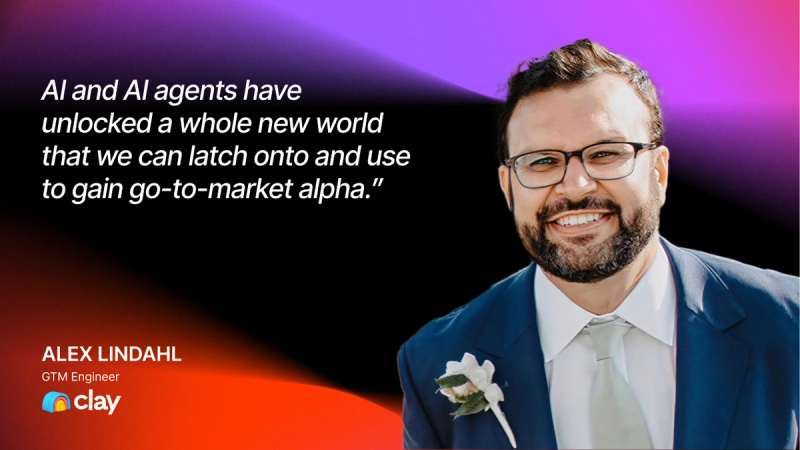
Clay - AI-native data enrichment and outbound automation platform that connects 75+ data providers to build targeted prospect lists and personalized outreach. Combines waterfall enrichment with AI agents to automate research, scoring, and messaging. Best for GTM teams running signal-based prospecting and account research workflows.
For account intelligence and personalization:
6sense - Revenue operations AI platform that identifies in-market accounts and orchestrates personalized campaigns with AI-driven decision making. Best for ABM teams targeting enterprise accounts with complex buying committees.
Demandbase - Account-based platform that streamlines advertising, sales intelligence, and personalization to optimize customer interactions and enablement. Shows which accounts are engaging with your content and enables targeted campaigns. Best for marketing teams running multi-touch ABM programs across paid, web, and email.
How to measure AI success
The fastest way to kill AI momentum? Measuring the wrong things.
You need a framework that connects AI activity to actual GTM outcomes. Build your metrics around three core categories:
1. Efficiency
According to our State of AI in B2B Video Report, 85% of marketers saved significant costs on video production, with 40%+ saving three hours on tasks like editing. Track hours saved, time-to-publish reduction, and content output increase.
2. Adoption
Tools that sit unused don't save anyone time, no matter how powerful they are. Monitor weekly active users, completed projects, and cross-team usage. When adoption dips, stop and figure out why before moving to the next use case.
3. Business impact
Connect AI directly to pipeline. Track influenced opportunities, conversion rate improvements, and time-to-market. Use RevOps dashboards to prove pipeline acceleration and closed revenue from AI-assisted campaigns.
AI for video: What actually works
Forget synthetic avatars. What CMOs actually need is to scale the authentic video content they're already creating.
A single webinar contains dozens of valuable moments—expert insights, customer stories, real human connections.
This is where AI-powered content creation delivers real gains:
- Start with authentic content (webinars, podcasts, customer success stories, customer interviews)
- Use AI to identify the most high-value moments
- Automatically package those moments for different channels (LinkedIn, email, SEO-optimized blogs, and more)
With the right tools, you’re not replacing authenticity—you're multiplying its reach.
Unlock AI across your GTM teams
When it comes to AI, experience compounds.
Every pilot teaches you something. Every successful use case gives you a playbook to scale.
Your next steps:
- This week: Identify one high-value, repetitive task AI could handle (content repurposing, email personalization, market research)
- This month: Document what works. Create playbooks from successful use cases.
- This quarter: Scale to 2-3 additional use cases. Measure everything.
Don't wait for the "perfect" AI strategy.
Start with one use case that drives clear value, prove the ROI, then expand.
Transform your video content
See how artificial intelligence can transform your video content into a demand gen engine
Transform Your Video Marketing with AI

© 2026 Copyright Goldcast, Inc. All rights reserved.
YOUR PRIVACY CHOICES