




 Upcoming Events
 Event Series
 On-Demand Events



The Challenge
Virtual events generate a burst of engagement and then go quiet. Registrations, attendance, a few social posts, maybe a recording link buried in a follow-up email. The ROI conversation ends a week later.
Goldcast's growth marketing team wanted to break that pattern. They planned a three-day virtual event, the Future of AI Marketing, co-produced with the AI Marketing Alliance, targeting marketing leaders evaluating how AI fits into their workflows, team structures, and tech stacks. The ambition was specific: build an event that would keep producing usable content for months after the last session ended.
That meant the event itself had to earn attention from senior practitioners. And the production workflow had to be designed from the start to turn live sessions into standalone assets (blogs, video clips, social content) without a dedicated content team spending weeks on post-production.
What You'll Learn
- How to recruit speakers who drive registration through credibility, not promotion
- How to design a production workflow that turns live sessions into content assets automatically
- How to structure multi-day programming that builds momentum instead of losing steam
Expected Results
- 40%+ attendance rate from a practitioner-quality lineup
- Growing session attendance across multiple days
- A library of derivative content (blogs, clips, social) produced within days, not weeks
- Engaged audience: ~30% of attendees asking questions or clicking resources
STEP 1
Recruit Speakers Who Are Actually Doing the Work
The team recruited fifteen speakers across nine sessions, drawing from companies where AI marketing is already in production, not theoretical. The lineup included:
- The growth lead at Anthropic
- CMOs from Demandbase and UserGems
- Zapier's SVP of Marketing
- Digital marketing leads from Notion and Wrike
- OpenAI's marketing operations team
- Specialists from Jasper, HeyGen, MoEngage, SmarterX, and Singulate
Kelly Cheng, Goldcast's CMO, hosted day three and moderated key panels.
STEP 2
Design Production for Content Output
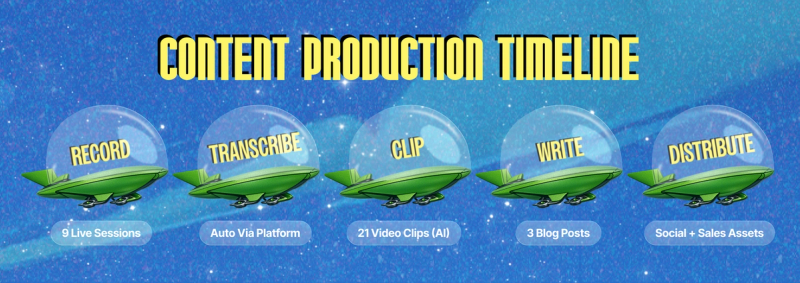
The event ran on Goldcast's own platform. Every session was recorded, transcribed, and immediately available for content extraction through Content Lab. The team used AI-powered clipping to pull highlight reels directly from session recordings, then turned full transcripts into long-form blog recaps covering each day's sessions in detail.
This was not a post-event scramble. The workflow was planned before the first session went live: record, transcribe, clip, write, publish. Each step fed the next.
STEP 3
Structure Each Day With a Clear Job
Each session had a clear job. The three-day arc was designed so topics built on each other, and the programming created compounding engagement.
- Day 1: Content strategy, GEO, and how marketing economics are shifting
- Day 2: Buyer signals, team adoption, and building internal tools without writing code
- Day 3: AI-driven workflows and agentic operations
The multi-day format created compounding engagement. Day two's closing keynote drew more than twice the audience of day one's opener, because attendees told colleagues and the social signal built over the week.
Results
Event Performance
Session-by-Session Live Attendance
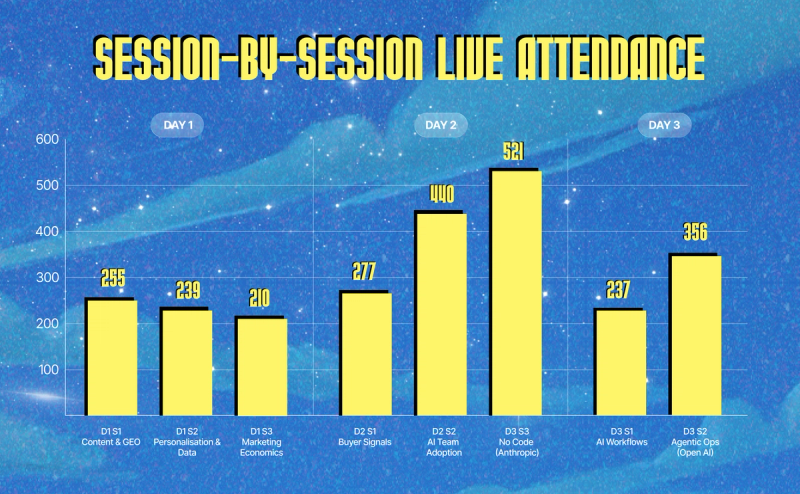
Attendance grew across the event. Day two's final session (Austin Lau, Anthropic) drew 521 live attendees, more than double the opening session. That suggests the programming built genuine momentum rather than losing steam after day one. The 170 additional on-demand viewers extend the reach beyond the live window.
Live Engagement Breakdown
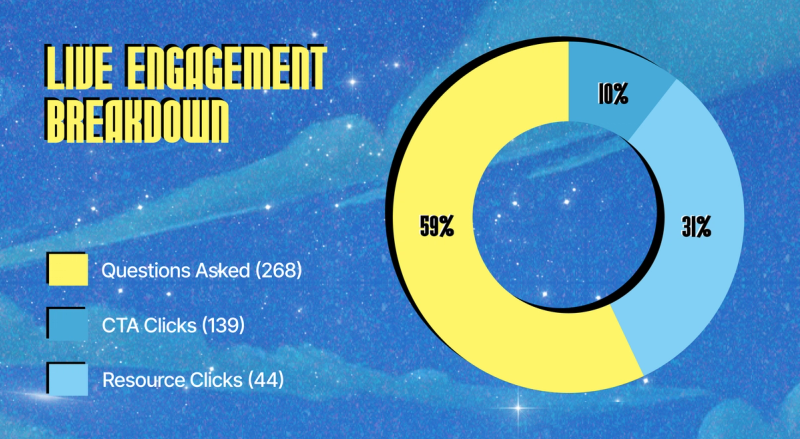
These are not passive viewers. Nearly 30% of live attendees asked at least one question or clicked a resource. That engagement feeds directly into lead scoring and sales follow-up.
Social Promotion
Five LinkedIn posts promoting the event generated 140+ likes, 60 comments, and multiple reposts. All organic reach from the speaker roster and co-production partnership, without paid promotion.
Pipeline Influence
The event did more than fill a content library. It moved pipeline. One month out, the Future of AI Marketing campaign is associated with $1.17M in open, active pipeline across 71 influenced opportunities, spanning stages from discovery through negotiation.
These are deals still in motion, not closed outcomes. The content engine keeps these opportunities warm long after the live sessions ended, giving sales a steady supply of relevant, credible touchpoints to move conversations forward.
The Content Engine
This is where the event keeps paying off. The three-day program produced a library of derivative content that the marketing team is still distributing weeks later:
- 3 long-form blog posts (one per day, each 2,500+ words) covering session highlights, speaker insights, and tactical takeaways
- 23 YouTube video clips pulled from session recordings using Goldcast's AI-powered Content Lab
- Social content adapted from speaker quotes, data points, and audience questions
Each blog post follows the same structure: session recap with embedded video callouts, direct quotes from speakers, and a FAQ section built from audience questions. They work as standalone reads. Someone who never attended the event can pick up any one of them and walk away with something useful.
The 23 video clips give the sales team a library of short, shareable assets featuring recognized industry voices. A BDR can send a prospect a two-minute clip of OpenAI's marketing ops lead explaining their Scout framework, or Anthropic's growth marketer walking through a no-code automation. Compare that to sending a generic event recording link.
Why This Worked
- Speaker credibility drove registration. Marketing leaders from OpenAI, Anthropic, Zapier, Demandbase, UserGems, Notion, and Wrike do not show up for vendor webinars. They showed up because the format was a practitioner conversation, not a product pitch.
- The content workflow was built into the event, not bolted on afterward. Every session was structured to produce clips, quotes, and blog-ready material from the start.
- Goldcast's own platform handled the entire pipeline: live production, recording, transcription, AI clipping, and content publishing. No third-party editing tools, no manual transcription, no six-week post-production cycle.
- The multi-day format created compounding engagement. Day two's closing keynote drew more than twice the audience of day one's opener, because attendees told colleagues and the social signal built over the week.
Want to see what this looks like for your team?
Goldcast helps marketing teams turn virtual events into a content engine. Live production, AI-powered clipping, and content publishing in one platform.