




 Upcoming Events
 Event Series
 On-Demand Events


What Every Marketing Team Actually Needs to Hear About AI in 2026

Table of Contents
Maximize Your Marketing ROI
Join 10,000 other marketers already getting the best tips on running engaging events that boost pipeline and create raving fans.
Day one of the Future of AI Marketing event was about strategy. The speakers talked about content systems, GEO, and what the marketing org of 2027 looks like. If you missed it, the recap has been published.
Day two, which we hosted on March 26th with the AI Marketing Alliance, was about doing the thing. Three sessions. Buyer signals with CMOs from Demandbase and UserGems. AI team adoption from Zapier’s SVP of marketing and their head of enterprise innovation. And a solo keynote from a growth marketer at Anthropic who ran the company’s entire growth operation for ten months without writing a single line of code.
Here’s what stood out.
Buyer signals are patterns, not individual data points
Rachel Truer, CMO at Demandbase, and Trinity Nguyen, CMO at UserGems, kicked off the day with a panel on buyer signals moderated by Cindy Dubon from Goldcast’s growth marketing team.
The conversation started with a simple question: what does “buying signal” actually mean? Rachel reframed it immediately.
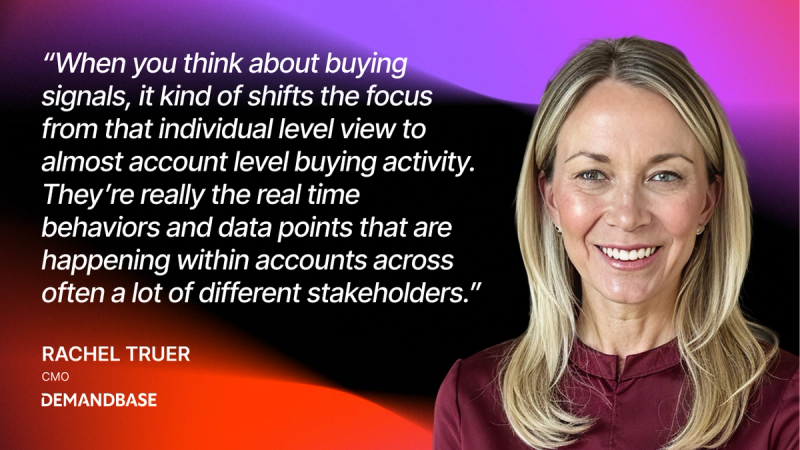
That distinction matters because most B2B teams still treat signals as isolated events. Somebody downloads a whitepaper. Somebody visits a pricing page. Somebody attends a webinar. Each one gets its own workflow, its own score, its own follow up. But the real picture only shows up when you stack them together and look at what’s happening across the account.
Trinity broke down her approach with a framework she called crawl, walk, run. Start with one or two signals. Get sales bought in on those. Prove the pipeline impact. Then layer more on.
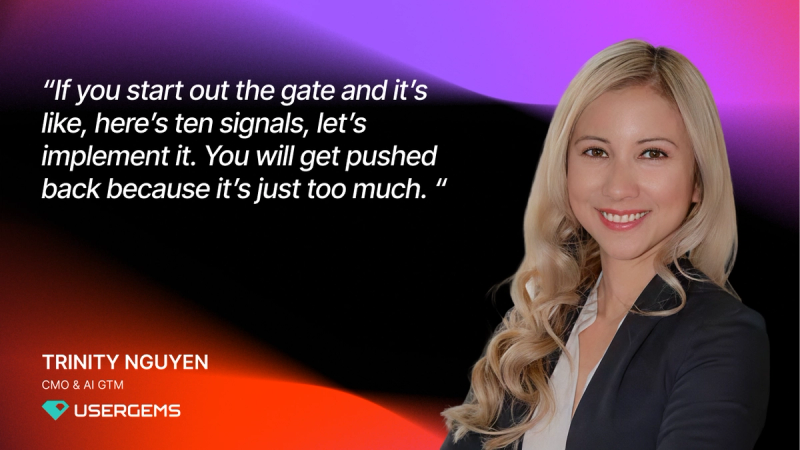
Her team at UserGems started with role changes. It’s a signal every sales rep already understands intuitively. When a former champion moves to a new company, that’s a warm introduction waiting to happen. Once that motion was working and pipeline was flowing, they added a second signal, then a third. Within three months, the full scoring system was in place.
One stat that got the room’s attention: accounts where someone attended a Goldcast event had a 3.4x higher close rate than accounts with no event engagement. That held true across virtual webinars, dinners, and conferences.
See how Goldcast event engagement data feeds your buyer signal strategy →
Stacking signals and letting AI do the scoring
The real shift, both speakers agreed, comes when you stop trying to manage signals manually and let AI handle the pattern recognition. Trinity put it plainly.
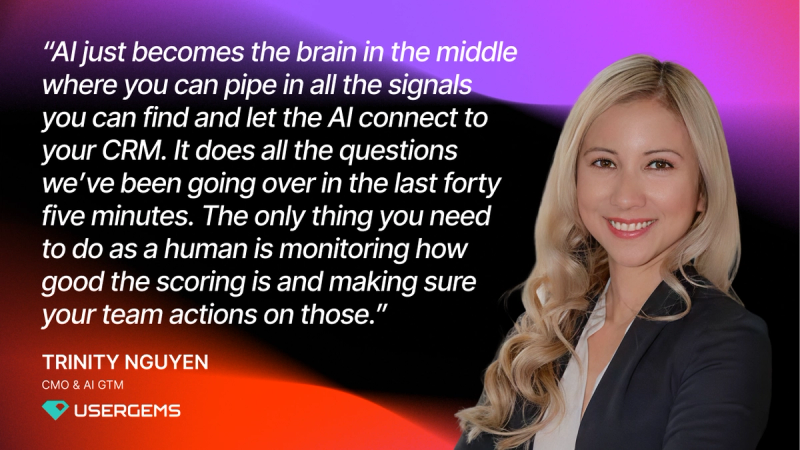
Rachel added that the goal should be moving from signals to outcomes. Start with high intent, in market accounts. Not your worst leads. Not your stalled deals. Pick the accounts where you already have evidence of buying activity, then measure whether signals are improving velocity, win rates, and deal size.
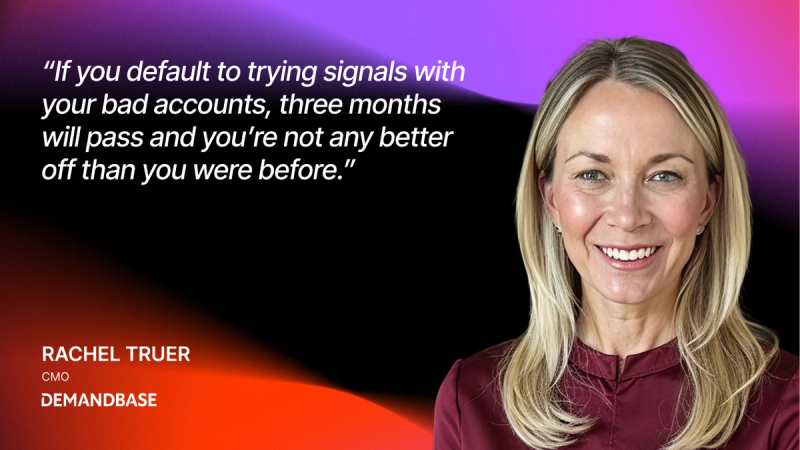
The message was clear on both sides. Signals work when they’re stacked, surfaced where reps actually look, and measured against outcomes that matter. The teams doing this well aren’t debating which individual signal is the magic one. They’re building a system that paints the full picture. And they’re not waiting until the system is perfect to start acting on it. The best results came from teams that picked a small batch of accounts, ran the motion with real conviction, and used the wins to pull the rest of the org along.
The confidence gap is the real adoption problem
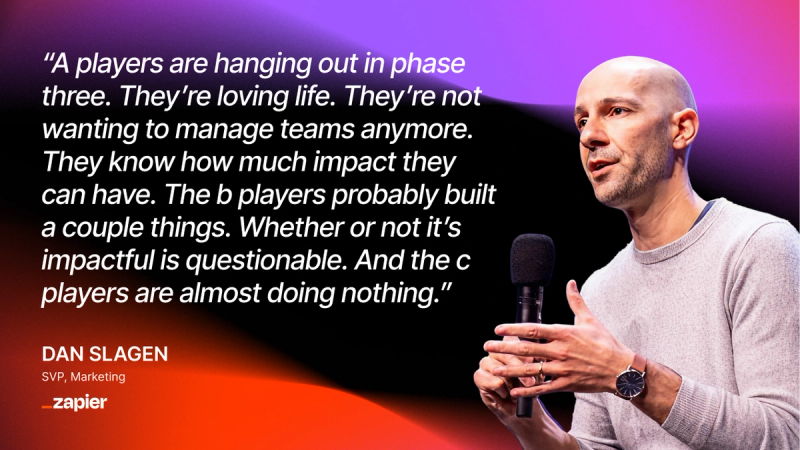
Session two featured Dan Slagan, SVP of marketing at Zapier, and Philip Lakin, Zapier’s head of enterprise innovation. Dan opened with a framework for thinking about the three phases of AI adoption that marketing teams have been going through.
Phase one was content creation. Drafting emails, generating images, writing press releases. The barrier to entry was low. You could get meaningfully better by the end of your first day using ChatGPT.
Phase two was role replacement. Using tools like HeyGen for product videos, AI SDRs for outbound, deep research with LLMs. Harder, but still accessible to most marketers willing to experiment.
Phase three is where things get uncomfortable. Agentic systems. Cursor, Claude Code, MCP connectors. Building real tools and workflows from scratch. And the gap between phase two marketers and phase three marketers, Dan said, is growing faster than anything he’s seen in his career.
Dan’s response to this at Zapier was a company-wide Build-a-thon. Every person on the marketing team (about seventy five people) had to build something using Cursor and Zapier’s MCP. They had thirty days. Before this, the majority of the team had never opened a tool like Cursor.
The first few days were rough. Token usage was flat. People were stuck. So they opened up training sessions, office hours, one-on-one buddy systems. By the second half of the month, usage spiked. On the final day, fifty builds got presented across nine different categories. One team built a fully automated speaker management system for their annual conference that’s now in production.
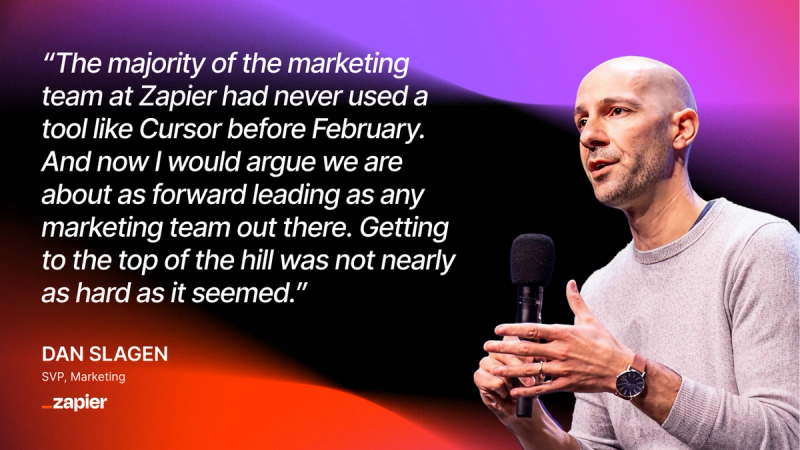
Philip Lakin brought a complementary perspective from working with enterprise teams on AI transformation. His advice was to resist the urge to reinvent everything on day one.
You earn the right for bigger reinvention once you’re doing those smaller, on the ground tasks. Give people time and space to learn. Don’t assume they know more than they do. Most people are just shy about what they don’t know.
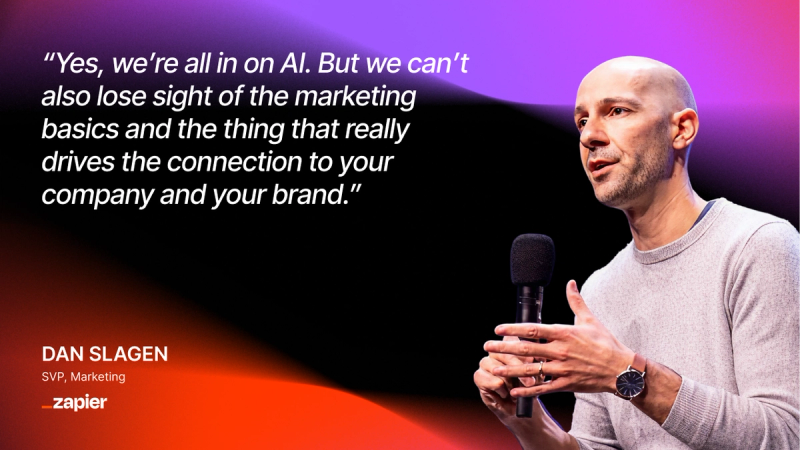
The other point Dan made that stuck with the room was about brand. In a world where every marketing team is going all in on AI, brand might be the last real differentiator. Zapier ran a Super Bowl commercial five months into Dan joining the company. They put Phil on billboards. They launched a character named Al who became so popular that people compared him to Flo from Progressive.
Build your own AI-powered event strategy with Goldcast →
You don’t need to know how to code to build real tools
Austin Lau, growth marketer at Anthropic, closed out day two with a keynote that put everything from the first two sessions into practice. Kelly Chang, CMO at Goldcast, introduced him with his backstory: Austin ran Anthropic’s entire growth marketing operation solo for nearly ten months. Paid search, paid social, app store optimization, email, SEO. All of it at one of the fastest growing AI companies in the world.
And he’s never written a line of code.
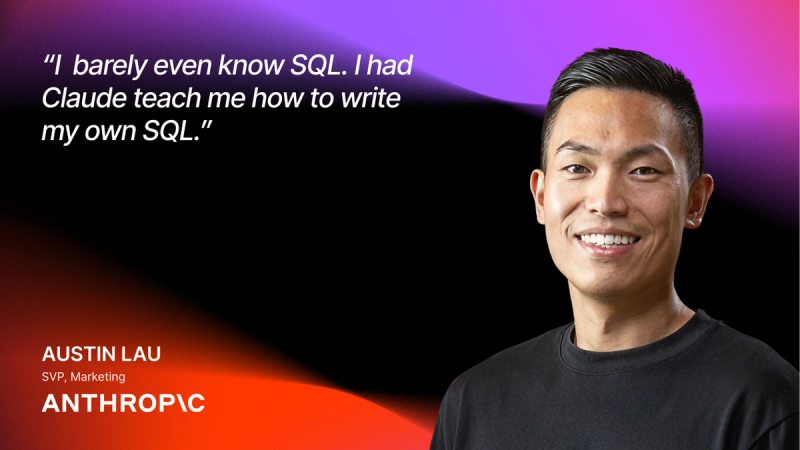
Austin’s core message was a mindset shift. Marketers have traditionally operated as channel managers. You own performance marketing, or lifecycle, or events. When you hit a technical wall, you file a ticket and wait quarters for engineering support. With tools like Claude Code, that wall doesn’t exist anymore. You can go from channel manager to product manager, owning the problem and the solution end to end.
He walked through two tools he built himself. The first was a custom Figma plugin that QAs creative assets against Anthropic’s brand guidelines. It pulls all the text from a Figma frame, sends it to Claude, cross references it against brand voice rules, font guidelines, spelling, grammar, and terminology restrictions, then flags issues with suggested fixes. The designers on his team now use it as part of their standard QA process.
The second was a Google Ads negative keyword workflow. Instead of exporting CSVs and manually reviewing thousands of search terms line by line, he built a plugin that connects Claude directly to the Google Ads API. Claude queries the search term report, analyzes relevance, flags terms that need to be negated, and can push the changes back into the ad account without ever leaving the workspace.
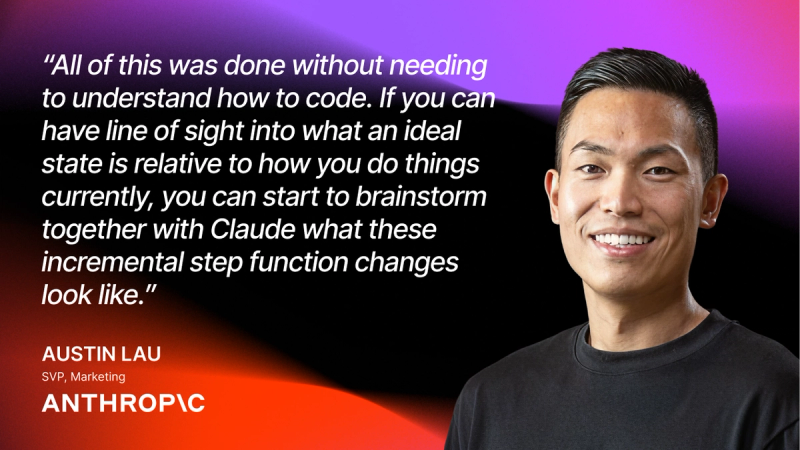
Austin’s framework for getting started was straightforward. Make a list across two dimensions: what’s manual and repetitive, and what’s something Claude might do better than you. Pick one item. Open Claude and describe how you currently do it. Ask if there’s a way to improve it. If something interesting comes back, ask Claude to spec out a plan. Then hand that plan to Claude Code and see what happens.
Repurpose your event content into 10+ assets with Content Lab →
What this means for your team
Three themes ran through every session on day two, and they all point in the same direction.
Buyer signals only matter if they lead to action. The teams seeing pipeline impact from signals aren’t collecting data for the sake of it. They’re stacking signals at the account level, letting AI handle the scoring, and measuring outcomes like velocity and win rates rather than counting MQLs. Event engagement data is some of the highest quality signal available, and the 3.4x close rate stat from the buyer signals panel backs that up.
See how Goldcast captures event engagement signals →
AI adoption is a confidence problem more than a skills problem. Zapier’s Build-a-thon proved that a marketing team with zero coding background can go from overwhelmed to building production-ready tools in thirty days. The turning point wasn’t technical training. It was creating the space to experiment, pairing people up, and letting them discover what’s possible on their own terms. Once people built one thing that worked, the anxiety disappeared and the momentum took care of itself.
And the line between marketer and builder is disappearing. Austin at Anthropic showed what happens when a non-technical marketer stops waiting for engineering support and starts solving problems directly. The Figma plugin took an hour. The Google Ads workflow took thirty minutes. Both are in production.
Day 3 of the Future of AI Marketing event covered AI operations and the future of work, with keynotes from Notion, OpenAI, and Wrike. That recap is coming next.
Turn Buyer Signals into Pipeline That Closes
Goldcast captures event engagement data that feeds your scoring models, personalizes follow-up, and gives your sales team the context they need to act fast. See how marketing teams are using events as their highest-quality signal source.
FAQs
What are buyer signals in B2B marketing?
Buyer signals are real time behaviors and data points that indicate an account may be in market for your product. These include things like website visits, content engagement, event attendance, job changes, funding announcements, and third party intent data. The most effective teams look at signals at the account level rather than the individual level, stacking multiple signals together to build a complete picture of buying activity.
How do you get started with buyer signal programs?
Start small. Pick one or two signals that your sales team already intuitively understands, like role changes or pricing page visits. Prove pipeline impact with a focused group of high intent accounts over sixty to ninety days. Once you have buy in and results, layer in additional signals and begin building out your scoring model. Trying to implement ten signals at once almost always leads to pushback and stalled adoption.
How is AI changing marketing team structure?
AI is shifting marketers from being channel managers to product managers. Tools like Claude Code and Cursor allow non-technical marketers to build internal tools, automate workflows, and create custom integrations without engineering support. This changes how teams are staffed, how work gets prioritized, and what skills matter most. Judgment, taste, and systems thinking are becoming more valuable than execution speed alone.
What is the best way to drive AI adoption on a marketing team?
Based on Zapier’s experience, the most effective approach combines a wake up moment (showing the team what’s already possible) with structured experimentation (giving people time, training, and a specific challenge to build around). Making it fun, pairing beginners with more experienced builders, and celebrating all levels of output helps turn initial overwhelm into lasting confidence.
Does brand still matter in an AI-first marketing world?
Yes. As AI makes production and distribution easier for everyone, brand becomes one of the few remaining differentiators. Zapier’s SVP of marketing made this point directly: while going all in on AI, they simultaneously invested in a Super Bowl commercial, billboards, live events, and a brand character. The companies that treat brand as optional while chasing AI efficiency may find themselves competing on price alone.
Transform Your Video Marketing with AI
© 2026 Copyright Goldcast, Inc. All rights reserved.
YOUR PRIVACY CHOICES