





 Upcoming Events
 Event Series
 On-Demand Events


What Five Marketing Leaders Actually Think About AI in 2026

Table of Contents
Maximize Your Marketing ROI
Join 10,000 other marketers already getting the best tips on running engaging events that boost pipeline and create raving fans.
We hosted the Future of AI Marketing buyer’s guide event with the AI Marketing Alliance earlier this week on March 25th. Day one brought five speakers from Jasper, SmarterX, MoEngage, Singulate, and HeyGen on stage to talk about content, personalization, and creative workflows in an AI world.
What stood out wasn’t the “AI is amazing” angle. Every speaker kept circling back to the same uncomfortable admission: most marketing teams know AI matters, but very few have actually changed how they operate because of it.
Here’s what came out of those three sessions.
Being good at content production is no longer the advantage
Mike Kaput, chief content officer at SmarterX, opened with a point that set the tone for the rest of the day. He described what he called a “complete inversion of the supply demand curve” in content.
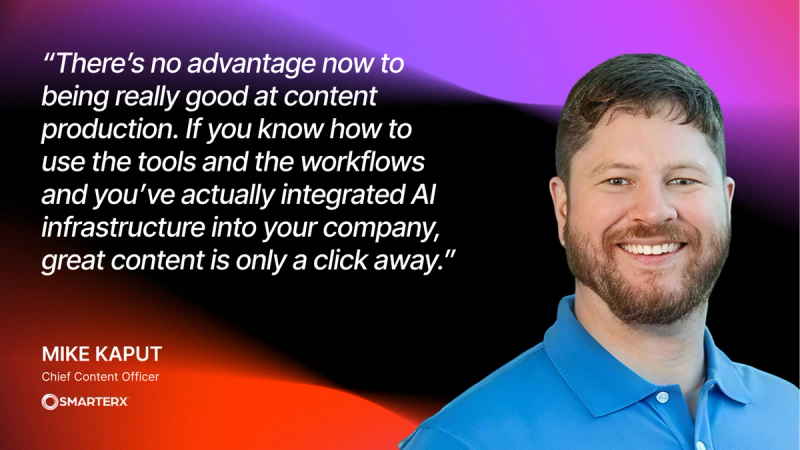
That sounds dramatic, but he’s not wrong. The tools have gotten good enough that a two-person team can produce what used to require eight. The question is whether teams are rethinking what they produce, not just how fast they produce it. And for most teams, the honest answer is no. They’ve bolted AI onto their existing process and called it a strategy. The output volume went up, but the thinking behind it stayed the same.
Esther Chung, head of comms and content at Jasper, put it a different way. “We’re shifting from doing the homework to grading the homework,” she said. At Jasper, that means marketers spend less time writing individual emails and more time encoding brand voice, positioning, and audience context into the systems that generate those emails.
Both speakers agreed on what the new advantage actually looks like: original research, proprietary data, and perspectives that only your company can offer. If AI can produce something similar with a prompt, it’s probably not worth producing manually.
What makes this shift so uncomfortable is that it forces teams to confront which parts of their content calendar actually carry weight. A lot of what marketing teams produce week over week exists because it’s always existed. The weekly newsletter. The monthly webinar recap. The quarterly industry roundup. None of that is necessarily bad, but when a competitor can spin up the same thing in an afternoon, the question becomes whether any of it is actually moving the needle.
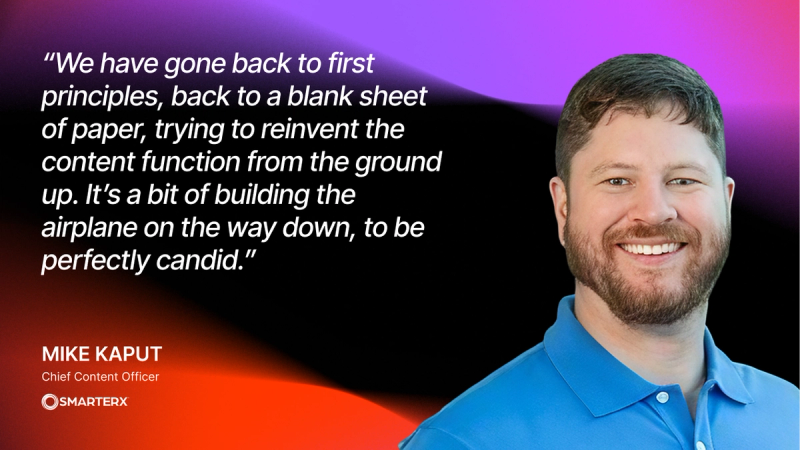
Mike’s team at SmarterX went as far as blowing up their entire content function and rebuilding from scratch.
See how Content Lab helps teams repurpose event content into 10+ assets →
Discoverability in an AI search world
The conversation naturally turned to GEO and getting your brand noticed in LLM search results. Everyone admitted they’re still figuring it out. The rules change almost monthly. But a few principles came through clearly.
Mike’s approach at SmarterX has been to “be discovered as many places as possible” by repurposing core assets like their weekly podcast into ten or more derivative pieces. They’ve also started restructuring written content with richer upfront summaries, making it easier for AI models to parse and cite.
Esther pointed out that AI search is making this a team sport in a way it never was before.
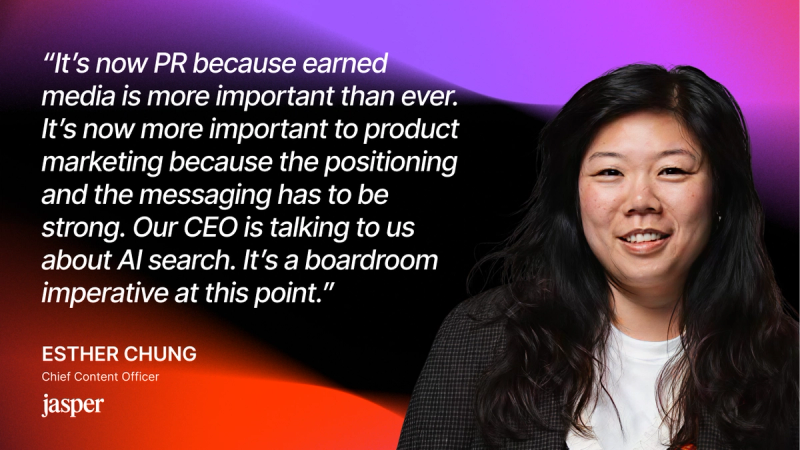
Nobody has the full GEO playbook figured out. But the teams investing in credible, well structured content backed by third party validation are going to be in the best position however the algorithms shake out.
The conversation around discoverability also surfaced a broader tension that kept coming up throughout the day. Marketing teams are used to owning a channel and optimizing it. SEO had rules. Paid had levers. Social had algorithms you could learn. With AI search, the rules are still being written, and they change fast enough that any playbook you build today might be outdated by next quarter. The teams handling this best aren’t trying to crack a code. They’re building a foundation of quality and authority that holds up regardless of how the discovery layer shifts.
If personalization feels personalized, you’re doing it wrong
Session two shifted to personalization. Anand Patel from the Goldcast product marketing team moderated, with Aditya Vempaty from MoEngage and Dave Schools from Singulate joining.
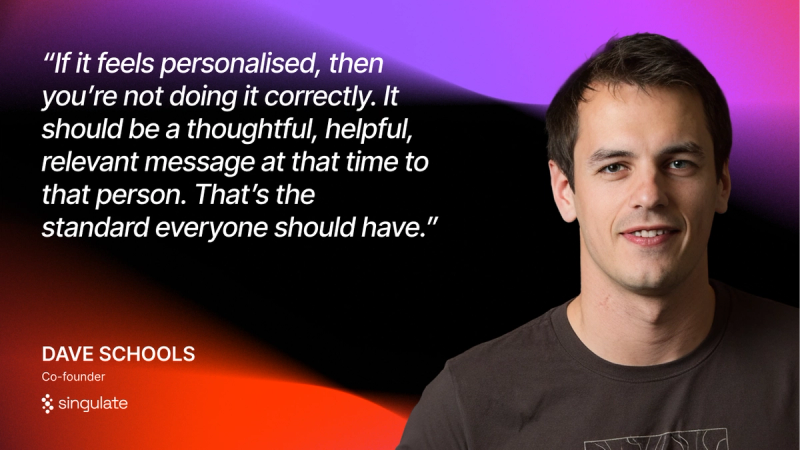
That distinction between personalization and relevance was the through line of the entire session. Most B2B teams are still doing what Dave called “what was invented in the eighties for snail mail,” dropping in first name tokens and calling it personalization.
The real problem isn’t data. It’s data strategy.
Aditya made the point that marketing teams don’t lack data. CRM data, intent signals, product usage data, third party enrichment. It’s all there. The gap is knowing what to do with it.
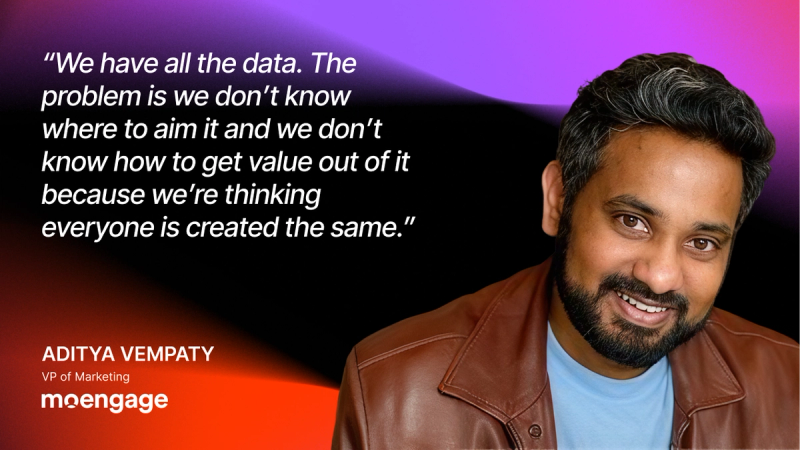
His recommendation was to start with the target account list and work backwards. Understand the industry, the use cases, the problems those specific accounts care about, then map the data you already have to that picture. The data strategy should begin with the end in mind, not with the database.
Dave expanded on this with what he called “the infinity tree” problem. If you try to segment by every data point (role, industry, company size, geo, lifecycle stage) you end up with thirty six versions of the same email. That’s where agentic workflows come in, handling the complexity of micro audience targeting that would be impossible to do manually.
The practical takeaway from both speakers was that personalization done well is invisible. The recipient doesn’t notice the machinery behind it. They just get a message that actually speaks to what they care about, when they care about it. That sounds simple, but getting there requires a level of intent data stitching and audience understanding that most teams haven’t invested in yet.
Both speakers were careful about one thing: keeping humans in the loop. The warning about AI SDRs and fully automated outbound was clear. “Don’t let AI send on autopilot,” was the message. Test at the contact level. Spot check outputs. If you wouldn’t send that message as a real one to one email after reviewing it yourself, don’t send it at scale either.
Turn event engagement into personalized follow-up with Goldcast Analytics →
The bottleneck moved from production to judgment
Holly Xiao, head of B2B marketing at HeyGen, closed out day one with a keynote that reframed the entire conversation. Her core argument: AI didn’t just make content creation faster. It changed the economics of planning, testing, and production. And once the economics change, the operating model has to change with it.
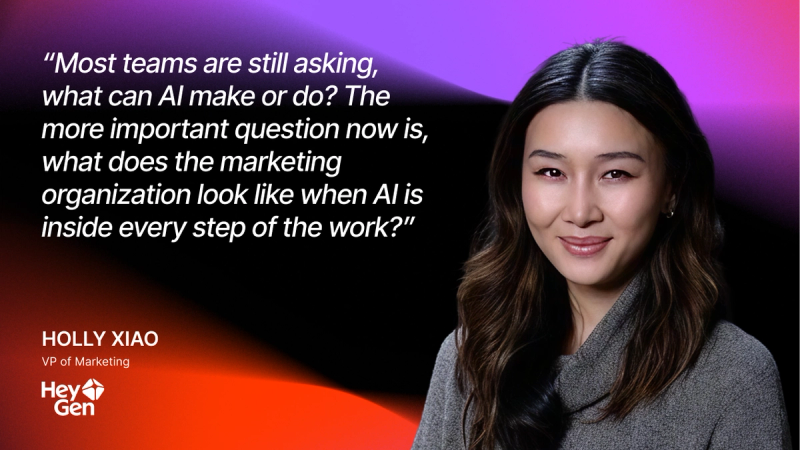
That question landed differently than anything else said on stage. It wasn’t about tools or tactics. It was about org design. And it forced the room to sit with the idea that the way most marketing teams are structured today was built for a world where production was the hard part. When production gets easy, the structure has to follow.
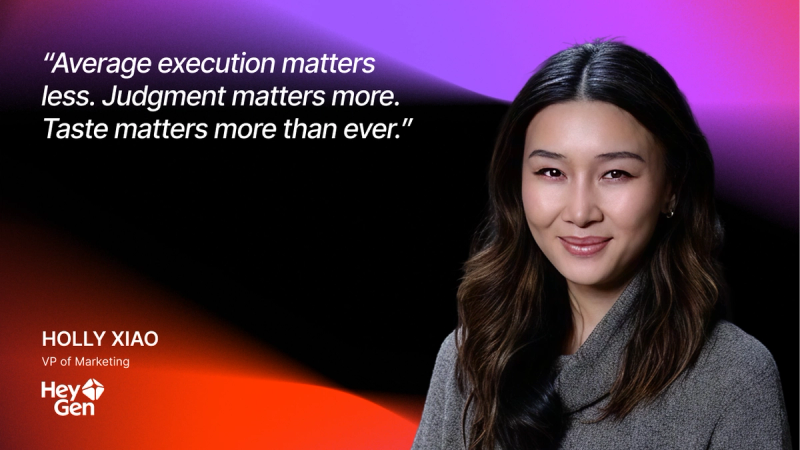
Her observation about “the squeezing of the middle” was one of the sharpest points of the day. AI hasn’t made top tier talent less valuable. People with strong judgment, taste, and strategic clarity are actually worth more now. What’s changed is the value of work that was historically centered on being pretty good across a wide range of execution tasks. B+ output is cheap to generate. The premium has moved upstream.
From campaigns to continuous learning systems
At HeyGen, Holly’s team rebuilt their workflow as a connected system rather than the traditional brief, produce, review, publish, evaluate cycle. Their old process evaluated launch results sixty to ninety days out. In a market that moves in hours, that doesn’t work.
Their new approach starts with signals, not content. Three intelligence layers feed everything they do:
- A trend system that runs daily scans across Perplexity, Grok, and other tools to catch what’s moving in their space. That feeds a fifteen minute morning standup they call “the morning hijack” where the team decides what to act on.
- A social intelligence system where their internal AI agent (named Palgen, with her own email address and Slack handle) reviews everything that happened across their social accounts the day before. Not just performance numbers. Sentiment, friction points, feature feedback, influencer mentions.
- And a customer intelligence system where every user interview goes into NotebookLM and becomes something the team can actually query.
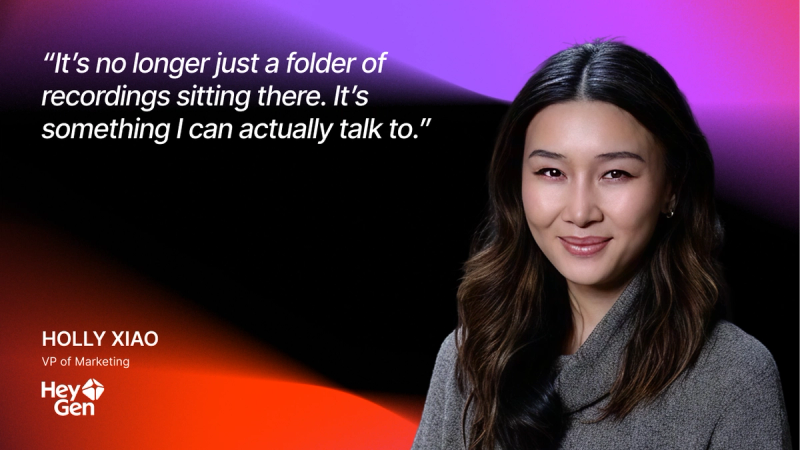
The principle behind all of it: “The goal is not more content. It’s faster learning.” The team that learns fastest wins. Not the team that ships the most blog posts. The one that spots patterns sooner and makes better bets because of them.
Build your own intelligence engine from live events with Goldcast →
What this means for your team
A few things came through clearly across all three sessions, and they’re worth sitting with.
Content strategy is becoming systems thinking. The advantage isn’t in producing individual assets anymore. It’s in building a repeatable engine that turns your best moments (events, interviews, customer conversations) into differentiated content that actually gets used. That’s the problem Content Lab was built to solve. And it’s why 89% of marketers now repurpose webinar content as part of their core workflow.
Personalization only works when it’s powered by real context. Event engagement data (who attended, what questions they asked, how long they stayed, which polls they answered) is some of the richest signal your team has access to. Using it to drive follow up that actually matches buyer context is where pipeline impact shows up.
And maybe the biggest one: the teams that win in 2027 won’t be the ones producing the most. They’ll be the ones learning the fastest. Shorter feedback loops. More experiments. Humans focused on judgment, taste, and the kind of point of view that only your brand can offer. Everything else is getting automated whether you want it to or not.
Day 2 of the Future of AI Marketing event on March 26th covered buyer intelligence and revenue, with keynotes from Zapier and Anthropic. We’ll have that recap up soon.
Turn Your Events into a Content Engine
Goldcast helps B2B marketing teams capture, repurpose, and personalize event content at scale. See how teams are using Content Lab, engagement analytics, and AI-powered follow-up to drive real pipeline.
FAQs
1) How is AI changing content marketing in 2026?
AI has made it possible for small teams to produce content at a scale that used to require large departments. But the bigger shift is strategic. Teams that are winning aren’t just using AI to write faster. They’re using it to build systems around original research, proprietary data, and unique perspectives that AI alone can’t replicate. The production advantage is gone. The new advantage is in having something worth producing.
2) What is the difference between personalization and relevance in B2B marketing?
Personalization traditionally means inserting known data (name, company, title) into messages. Relevance means delivering the right message at the right time based on what someone actually cares about. The best personalization feels invisible. The recipient shouldn’t notice the tactic. They should just feel like the message was useful and timely.
3) How are marketing teams using AI for event follow up?
Some teams are using AI to analyze event transcripts, pull out the most relevant takeaways for different audience segments, and match follow up content to each attendee’s role and engagement behavior. Instead of sending the same recap email to everyone, they build follow up sequences based on what each person actually engaged with during the session.
4) What does GEO mean for B2B marketers?
GEO (Generative Engine Optimization) is about making your content discoverable by AI models like ChatGPT, Perplexity, and Google AI Overviews. The teams doing this well are structuring content so it’s easy for models to parse, earning third party mentions and citations, and maintaining consistent messaging across every surface where LLMs might pull information.
5) How should marketing teams think about AI and brand quality?
AI makes production faster, but quality still comes from humans. Use AI for early stage drafting, research synthesis, and repurposing. Keep human review for judgment calls, brand consistency, and final editorial sign off. The teams getting this right use AI to generate options and humans to decide which ones are worth putting into market.
Transform Your Video Marketing with AI

© 2026 Copyright Goldcast, Inc. All rights reserved.
YOUR PRIVACY CHOICES