




 Upcoming Events
 Event Series
 On-Demand Events


The Mindshare Marketing Framework
Powered by Goldcast
How Brands Win Before the Search Begins
We like to think we choose. But most choices are made for us, long before we act on them.
That’s why some brands feel inevitable. Not because they’re better, but because they’re familiar. They arrived first and never left.
Here’s the reality:
80% of B2B buyers already have a 'shortlist' of brands in mind before their search begins and 90% ultimately choose the first brand they had in mind.
Not after weeks of research. Not after a deep RFP. Just first.
This (objective-based) realization is a systemic paradigm shift from how B2B marketers have operated over the last decade. While it makes sense, it's counterintuitive to the way we've learned, taught, and operated.
Want to do something about it? Let's start by talking about how you can leverage it.
The Mindshare Marketing Framework
Mindshare = Video-First Content + Resonance + Consistency
Attention is a welcome stranger with a curfew. It comes and goes.
Sure, the dopamine spike of being noticed is fleeting, and that's tantalizing for brands. But what matters is what sticks.
The real goal is to occupy space in their mind through willing acceptance.
That’s mindshare marketing.
Mindshare marketing is a system for becoming the brand they think of first, without Googling, without prompting, without question.
Before we get into the juicy stuff, here’s why this matters:
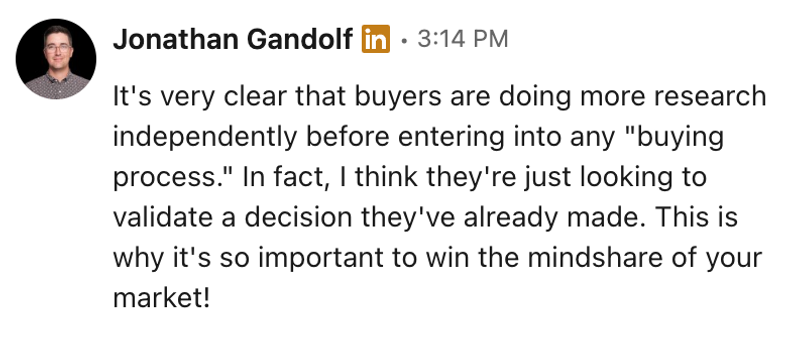
Attention is cheap. Memory is priceless.
Most marketers measure noise instead of memory. They optimize for clicks, not recall. They chase leads and miss perception.
So they disappear when the scroll stops.
For you, that ends now.
What follows is a system I wish every marketer knew. It’s not a hack. It’s not a trend. It’s a formula for being remembered.
Here’s what you’ll get:
✓ A clear, durable model for building brand memory and recall
✓ Specific content plays to make video your most leveraged asset
✓ Indicator metrics that expose whether you’re forgettable or unforgettable
✓ A map to becoming the first name buyers think of before the search begins

V = Video-First Content
Most B2B content is skimmed. Video is experienced.
Video content is cognitive leverage.
Why?
Because video mirrors how we actually remember (faces, tone, rhythm, story). It's consumed but it’s also relived. It lets us be authentically human.
If that wasn't enough, it's objectively proven that people prefer video over every other content format.
So why not give the people what they want?
Key stats
- 95% of a message is retained via video
- 80% of people prefer it over text
- Video is the #1 medium for emotional resonance and recall
How to leverage video-first content
✓ Treat every live event, webinar, or meeting as raw material
✓ Don’t just “do” video. Operationalize it.
✓ Every live event, webinar, and meeting = a video content engine.
✓ Use AI to extract 10+ assets per event (clips, quotes, highlights, recaps).
✓ Publish across funnel (from awareness to post-sale advocacy).
✓ Use human faces, voices, and emotional storytelling to build trust.
✅ Outcome: Your message gets stored, not scrolled past.
R = Resonance
If video is how you show up, resonance is why they remember you.
You have to matter.
That means saying something that sticks emotionally, aligns with what they care about, and makes them feel understood.
When your message is felt, that’s resonance.
The reason for that is simple.
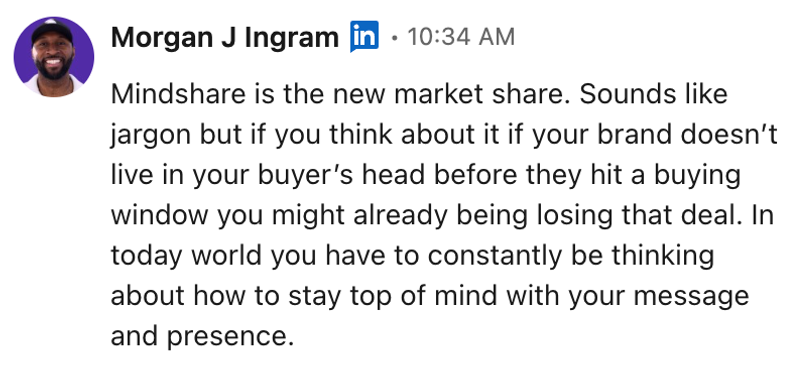
Our brains store emotion better than explanation. We remember the stories that hit us in the chest, not just the ones that made sense.
Here’s the truth.
Relevance is table stakes. It’s a necessity.
Resonance is the multiplier that takes things to a new stratosphere.
It’s the difference between being seen and being remembered.
Key stats
- 92% of consumers trust organic content over traditional ads
- B2B video content boosts brand awareness and engagement by 91%
- Only 25% of consumers remember both an ad and its brand one day later
- 36% of consumers trust user-generated content most
How to leverage resonance
✓ Coin a term (like “mindshare marketing”).
✓ Attach it to a pain point (e.g., “Without video, you're invisible”).
✓ Anchor your message in real human tension (not features)
✓ Prioritize emotional storytelling over generic narration
✓ Use language that’s vivid, rhythmic, and unmistakably yours
✓ Choose topics your audience already feels, not just what you want to sell
✓ Repeat your key idea until it becomes familiar shorthand for the problem
✅ Outcome: You become less of a “brand” and more of a belief.
C = Consistency
Repetition is reputation.
Consistency isn’t about posting 100 times a month. It’s about showing up with cadence, across platforms, with a clear and narrative-driven message.
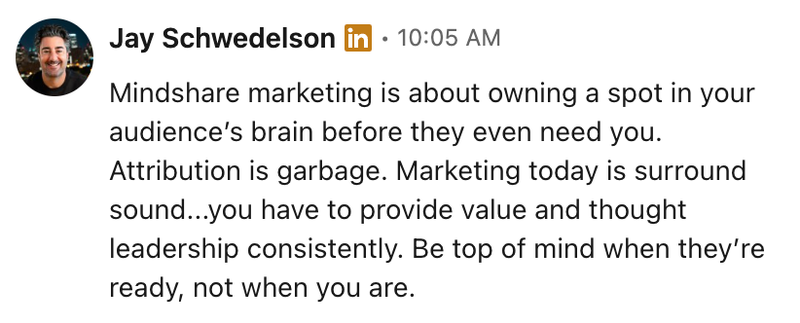
Buyers just need you to be present often enough, and familiar enough, to earn their trust before they even realize they’re in-market.
While most b2b marketers hold onto volume, mindshare is actually won through predictability.
In other words, say the same thing a hundred different ways.
The brands that drive insane recall the most mentally available when the time comes.
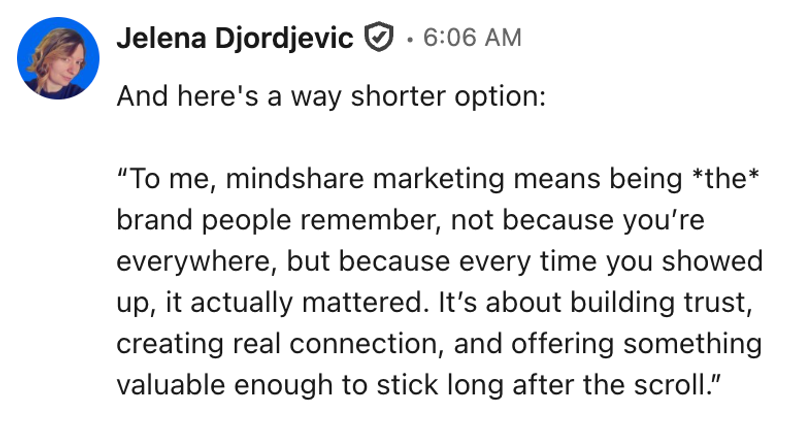
Consistency turns scattered content into identity. It trains your audience to expect you, remember you, and trust you.
Key stats
- 60% of consumers expect brand consistency across platforms
- 32% of companies report consistent messaging drove 20%+ revenue growth
- Consistent brands achieve 2× the profit gains and need 1.75× less media spend compared to inconsistent ones
- Consistently presented brands are 3–4× more likely to have high visibility
How to leverage consistency
✓ Use recurring formats to build brand memory (e.g. series, shows, themes)
✓ Match tone, style, and POV across channels
✓ Centralize your brand story and reinforce it in everything (from webinars to clips to blogs)
✓ Build a publishing rhythm your audience can rely on
✓ Treat every campaign as a chapter in a longer narrative
✅ Outcome: You become the obvious answer before the question's even asked.
How to Measure Mindshare

Because mindshare marketing is still a relatively new concept in practice, it requires intentional thinking around what should be measured. That means looking beyond the usual KPIs.
It’s time to rethink what really matters, including the metrics most people aren’t paying attention to (yet).
📈 Key mindshare indicators that matter
Share of Voice (SOV): Your brand’s presence vs. competitors across digital channels.
Branded & Category Term Search Volume: Are more people actively Googling your brand name? Are people using your coined phrase in social and search?
Net Promoter Score (NPS): Especially for post-sale mindshare: High NPS often correlates with word-of-mouth brand reinforcement.
Social Mentions & Sentiment: How often and how positively is your brand discussed?
Event Attendance & Replay Rates: Are people showing up and revisiting your live content?
Share of Search (SoS): Branded search queries / Total category search queries. Indicates brand strength vs. competitors. (Use SEO tools like Moz or Semrush.)
Social Share Rate: The percentage (%) of people who shared a piece of content vs. how many saw it. Use tools like BuzzSumo, Sprout Social, or native LinkedIn/X analytics. A high share rate signals content that emotionally or intellectually clicks.
Video Clip Repurposing Ratio: The number of clips created from one long-form event/video. Target = 10+:1 (Helps measure content scalability and flywheel execution.)
Content Volume per Channel: The number of net new or repurposed posts/videos went out per platform. Helps ensure multi-touch omnipresence.
Employee Social Advocacy Rate: The percentage (%) of employees who regularly post each month (LinkedIn). Tools: Shield, EveryoneSocial, or manual tracking.
Employee Amplification Rate: The percentage (%) of employees who reshare brand content. EveryoneSocial, GaggleAMP, or Shield for LinkedIn. Indicates internal brand alignment and boosts your share of mindshare within networks.
Customer/ICP Content Participation: The number of customers featured in case studies, video clips, UGC, or events per quarter.
Referral-Initiated Deals: The number of deals sparked by a referral or social share (Salesforce attribution, partner tags, etc.)
Anti-Mindshare Checklist: What to Fix First
These red flags are silently killing your brand's ability to stick in buyers' minds. Eliminate these to start compounding attention into recall.
❌ Inconsistent Messaging
Your brand story shifts depending on who’s telling it.
⚠️ You’re guilty if: You can’t sum up what your company does, and why it matters, in one consistent sentence across teams.
Examples
- Homepage says one thing, LinkedIn bio says another.
- Your sales team is using a different deck than marketing’s core narrative.
- You’ve run three different campaigns this year—none connected by a through-line.
- You’re not known for a clear idea, phrase, or market POV your audience can repeat.
- Your positioning feels like a mix of jargon from other companies in your space.
❌ No Signature Format or Voice
You create content, but none of it feels like you.
⚠️ You’re guilty if: Nobody could identify your content in a feed without your logo on it.
Examples
- Your brand design looks like a default Canva theme—no edge, no identity.
- You don’t have a recurring show, series, or content format your audience expects.
- No consistent host, face, or voice people associate with your brand.
- Every blog, video, and post sounds like it was written by ChatGPT on default mode.
- If your content was stripped of logos, no one could tell it’s yours.
❌ Product-First, Problem-Last Content
You’re leading with features instead of leading the conversation.
⚠️ You’re guilty if: Your top-performing content lives on the pricing page, not in your blog or brand channels.
Examples
- Most of your messaging sounds like a feature checklist, not a category POV.
- Your videos explain “how it works” before they explain why it matters.
- Even your thought leadership ends up pitching features.
- Your headlines could double as software documentation.
- Your product pages have more drop-downs than narrative.
❌ Low Video Velocity
Your events and webinars vanish into a content graveyard.
⚠️ You’re guilty if: Your most expensive, high-effort content has zero follow-up distribution plan.
Examples
- You publish once, then go dark for weeks.
- No consistent output of short clips, recaps, or thought-led snippets.
- No one owns video repurposing—or it happens manually, too slowly.
- Videos are stiff talking-heads with no energy, movement, or storytelling.
- You’re still prioritizing PDFs over punchy video formats.
❌ “One and Done” Content Strategy
You launch and leave. No flywheel. No compounding memory.
⚠️ You’re guilty if: Your audience only sees your content when you’re promoting something.
Examples
- You create great content, but don’t recycle or remix it.
- Your campaigns die the moment they’re published.
- You hit “publish” and forget to promote again for weeks.
- There’s no system to surface high-performing content across channels.
- You rely on launches instead of building a consistent stream of visibility.
Putting It All Together
In a world of infinite options, the default wins.
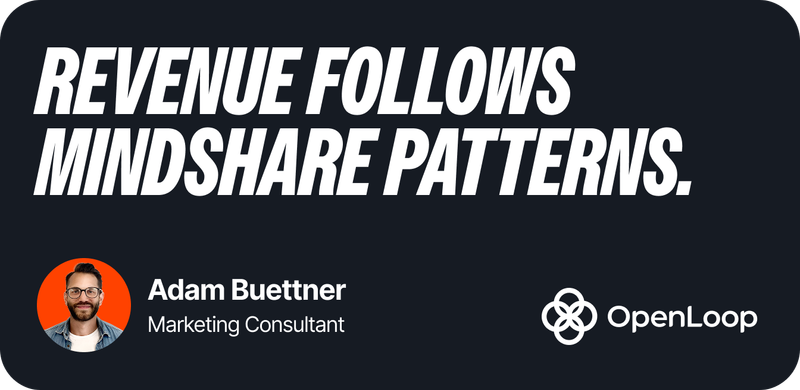
Mindshare is earned before the search. Not during. Not after.
Mindshare is the outcome. The formula is how you get there.
At Goldcast, we happen to have the platform that makes it scalable.
The future of marketing isn’t louder or faster. It’s smarter, rooted in how people actually think, choose, and remember.
That’s the game. And now you know how to play it.
▼ FAQs
1. Why is Mindshare Marketing important for B2B companies?
Most B2B buyers make key decisions before talking to sales—70% of their journey is complete before contact, and 90% choose vendors already in mind. Mindshare marketing ensures your brand is remembered and trusted early, helping you win deals before competitors are even considered, reducing pipeline friction, and increasing conversion rates.
2. How is Mindshare Marketing different from demand generation?
While demand gen focuses on capturing intent, Mindshare Marketing happens earlier—before intent exists. It builds recognition that influences future buying decisions.
3. How do you achieve Mindshare Marketing?
The Mindshare Marketing Framework focuses on three pillars: video-first content that humanizes and educates, resonance that creates emotional connections and message recall, and consistency that keeps your brand visible and trustworthy. Together, these elements make your brand memorable and the default choice for buyers when it’s time to purchase.
4. Why does mindshare matter more than brand awareness?
Brand awareness means people know you exist. Mindshare means they remember you when it counts—during purchase decisions. It’s the difference between seen and selected.
5. How can video content drive mindshare at scale?
Video is the most memorable medium, with 95% retention versus 10% for text. Goldcast’s AI-powered platform makes creating and distributing branded video content scalable across the buyer journey.
6. What role does AI play in executing a mindshare strategy?
AI accelerates content creation and repurposing, allowing marketers to show up more often with less effort. This sustained presence helps increase total impressions and brand recall.
7. How can B2B brands start building mindshare today?
Start by creating consistent, video-first content tied to demand spaces your audience cares about. Focus on resonance over reach, and distribute across multiple formats and channels.
-- Sources: [1] Harvard Business Review (HBR) [2][3] Speach.me [4] SoCal News Group [5] Firework [6] Offbeat [7] Nielsen [8] Sprout Social [9] RightMarket [10] Exploding Topics [11] Funnel [12] Marq

Stay In Touch
Platform
Resources
Company
© 2026 Copyright Goldcast, Inc. All rights reserved.
YOUR PRIVACY CHOICES