




 Upcoming Events
 Event Series
 On-Demand Events


How Lattice and Gamma Turn One Event Into Months of Content

Table of Contents
Maximize Your Marketing ROI
Join 10,000 other marketers already getting the best tips on running engaging events that boost pipeline and create raving fans.
Most B2B events follow the same pattern. You spend weeks planning, run the event, send a follow-up email, and move on. The content you captured sits in a folder somewhere. The pipeline impact fades within days.
Elena from Lattice and Mark Iafrate from Gamma joined a Goldcast Insider session with nearly 900 marketers to explain how they broke that pattern. Both run small teams. Both treat events as the starting point of content production, not the finish line. And both shared the specific playbooks they use to keep a single event generating pipeline for months after it ends.
Lattice's Model: One Conference, Three Quarters of Content
Latticeverse is Lattice's annual conference, held in San Francisco and London. Elena described it not as an event but as a "multi-quarter content and pipeline engine" that takes over the year.
The planning starts 10 months out. The content team (two people) works with product marketing, engineering, and leadership to align session topics to the product roadmap and market signals. They also pull from a direct source that most teams overlook: post-webinar surveys. Lattice runs 30 to 40 webinars per year, and each one ends with a survey asking attendees what topics they want next. This year, Elena pulled about 300 to 400 topic suggestions from that data and ran them through AI to find patterns.
Once the event happens, the capture plan kicks in. Every session is recorded. A camera crew covers the experiential moments for sizzle reels. The product team reviews transcripts and flags the best clips down to the minute.
Then the repurposing machine starts.
Lattice runs a "Best of Latticeverse" replay series using Goldcast, turning recorded sessions into mock-live webinars for the audience that missed the in-person event. They run co-marketing replay sessions with event sponsors. They cut 20 to 40 second promo clips for social. They build full promotion campaigns around the event content across email, paid, LinkedIn, and PR. The annual anthem video from the keynote becomes the product story asset for the rest of the year.
Each session topic from Latticeverse becomes a content pillar. A keynote about AI in HR, for example, first airs as a live session, then becomes a replay webinar, then gets broken into a more focused follow-up webinar ("How does the Lattice HR team use AI to be more efficient?"), then feeds social clips and email campaigns.
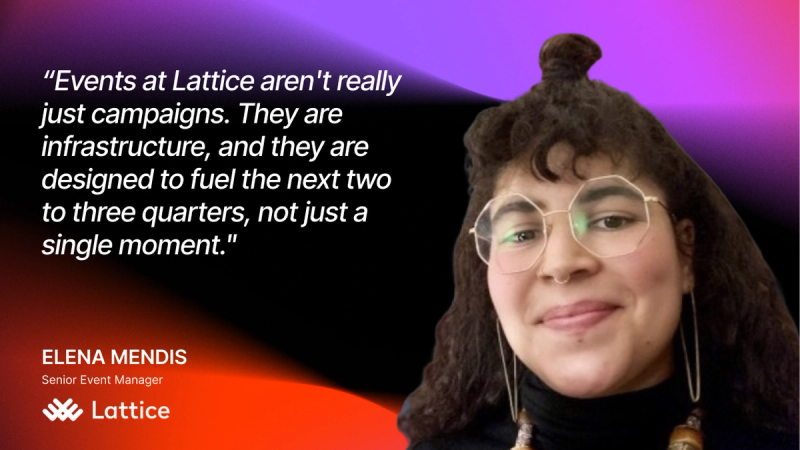
This isn't a content team operating alone. The social team, brand design, customer success, and product all play roles. Customer success surfaces speakers and secures approvals. Product reviews transcripts and identifies the best moments for clips. It is a company-wide motion, and Elena credited CEO Sarah Franklin (a former CMO) for driving that top-down buy-in.
Mark's Model: The Content Flywheel From a Single Webinar
Where Elena showed how to build a content engine from a major tentpole event, Mark zoomed in on something more accessible: getting months of value from a single webinar.
Mark built webinar programs at Intercom and now leads B2B marketing at Gamma, a visual communication platform with 70 million users globally. He noticed that most webinar programs eventually hit a ceiling, and it is not because the content is bad. It is because the value gets captured only during the live event or the day or two surrounding it.
His fix is what he calls the content flywheel. The live session is just one point in time. Everything before and after it is a system designed to keep adding value.
Here is how it works in practice, using a customer case study webinar as the example:
Before the webinar: Mark finds the right speaker (usually through a CSM or AE referral), schedules a 30-minute discovery call, comes with open-ended questions, and hits record. He transcribes the full conversation, feeds it into AI, and turns it into a narrative talk track with questions and bullet-point responses. That document gets shared async for review. Then comes a standard dry run, which also serves as the first time many speakers actually engage with the content.
During the webinar: Goldcast records and transcribes everything. Chapters are turned on by default because, as Mark put it, nobody watches a full recording.
After the webinar: The recording goes to an on-demand page. AI generates a summary and key takeaways. The 24-hour post-webinar follow-up goes out. And then the flywheel begins.
Mark takes the live recording, the transcript, and the discovery call notes, combines them, and uses AI to brainstorm derivative content. But he is selective about what gets made. His rule: produce what your business needs most and what you can actually activate and distribute.
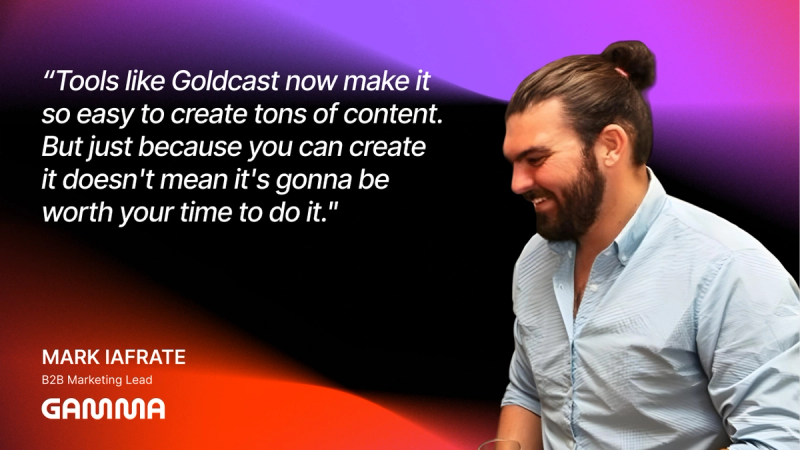
He focuses on one or two derivative pieces tied to different funnel stages. A customer case study webinar, for example, might produce a polished case study for the sales evidence library and a downloadable playbook as a gated offer. Everything links back. The on-demand confirmation email links to the playbook. The case study page links to the gated on-demand recording. The playbook links back to the case study. No dead ends.
When to Stop Repurposing
Both speakers addressed the trap that catches teams when they first start repurposing: doing too much. The instinct is to turn every webinar into five blog posts and ten social clips. The result is a pile of content that nobody distributes and nobody sees.
Elena's filter is straightforward: know your audience and know your channels. At Lattice, the HR audience wants key takeaways on the webinar landing page and a social post that reminds them to watch. That is where the team focuses.
Mark's filter is more ruthless. He starts with the biggest business gap, not the topic. At Gamma, the gap right now is approved customer case studies for the website. So his webinar programming and repurposing priorities flow from that need, not from a checklist of content formats.
He also shared a tactic for saying no to internal requests: give the requester work to do. If someone wants a batch of social clips created, Mark gives them a ContentLab seat and says go for it. If they want a full promotion plan built around those clips, he asks them to write the email copy and put together the distribution plan. If they are still willing to do that work, the request is real. If not, it goes to the next cycle.
Distribution is the Real Bottleneck
Both speakers kept coming back to the same point: creation is no longer the hard part. AI and tools like Goldcast's ContentLab have made content production fast. What actually matters now is whether anyone sees it.
Mark encouraged the audience to map out every distribution channel available and then prioritize based on two factors: what is most impactful and what is within your control. Can you send email promos? Can you get something published to the website? Can you get it posted to social in a format that drives clicks, not just views?
He also flagged internal enablement as a blind spot. Sales reps will not dig through an internal repository to find webinar content. You have to push it to them directly and explain what it is, why it matters to their deals, and how to use it.
Two-Person Teams Are Doing This
The audience's most common question was about team size. Elena's content team at Lattice is two people. Mark's team at Gamma (a 70-person company) is even smaller.
Mark's take: with AI, a single person can now create a wide array of content from a webinar transcript. The value of additional people comes from domain expertise, not production capacity. Someone on customer advocacy knows what evidence sales needs. Someone on product marketing knows how to position a product launch clip. Someone on social knows what format works on LinkedIn. Their guidance matters more than their hands on a keyboard.
The sweet spot, he said, is two to three people with clear roles. And even then, the emphasis should be on distribution planning, not just creation.
Attribution Is Your Unlock
Both speakers made the case that content repurposing becomes sustainable only when you can prove it works in business terms.
Elena described how Lattice tracks Latticeverse engagement across two to three quarters. A webinar in December that originated from a June conference session still shows up on their tracking dashboards as event influence. That attribution data is how they secure and renew budget year after year.
Mark put it bluntly: nothing gets buy-in better than a single executive summary slide that says "the four webinars I ran last quarter generated 250K in pipeline." If you do not have a way to point to business impact, prioritize building that measurement capability before you scale repurposing.
His advice on reporting: always use the language of whoever you are presenting to. The head of sales cares about opportunities and ARR. The head of demand gen cares about pipeline and MQLs. Same data, different framing.
Want to see how Goldcast customers are building content engines from their events?
Start Small, Distribute Well
The session closed with advice for teams that have not started repurposing yet.
Elena: "Just try. A social post counts as repurposing. Start there."
Mark: "Start with what you're already on hook for. If you know you need an ebook, check your webinar library first before building something from scratch."
And from both: before you create anything new, figure out how you will get it in front of people. The distribution plan matters more than the content itself.
Turn your next event into a content engine
Goldcast's Content Lab helps you repurpose webinar recordings into clips, blogs, social posts, and more.
FAQs
How do you keep repurposed content feeling fresh months after the original event?
Lattice mixes older content with new data from a mid-year survey to create hybrid pieces. Mark recommends tying content to evergreen themes and removing timestamps from on-demand pages when the content is still relevant. He also suggested combining clips from multiple webinars into new assets like sizzle reels or bundled playbooks.
How far in advance should you plan for content repurposing?
Elena plans Latticeverse repurposing as part of the original event strategy, 10 months out. Mark said 90% of the time he knows from day one that a webinar will be repurposed. The question is not whether to repurpose but how. He recommends having a general plan but staying flexible enough to pivot based on what actually comes out of the live session.
What size team do you need to build a content engine from events?
Lattice does this with a content team of two, supported by cross-functional contributors across social, brand design, customer success, and product. Mark said one person with AI tools can now produce a wide range of derivative content. The ideal is two to three people with complementary domain expertise, not a large production team.
What is the best way to prove ROI on event content repurposing?
Track influence over multiple quarters, not just the week after the event. Lattice attributes repurposed content engagement back to the original event across two to three quarters. Mark recommends presenting results in the language of whoever controls the budget: pipeline and opportunities for sales leaders, MQLs and attributed leads for demand gen.
What should you repurpose first if you are just getting started?
Both speakers said to start with what you are already on the hook for. If you need a case study, check whether a recent webinar already has the customer story you need. If you need social proof, pull a 30-second testimonial clip from a session recording. Focus on one or two pieces you can actually distribute, not a long list of formats.
Transform Your Video Marketing with AI
© 2026 Copyright Goldcast, Inc. All rights reserved.
YOUR PRIVACY CHOICES