




 Upcoming Events
 Event Series
 On-Demand Events


Podcast Platforms: Top Hosting, Recording, and Production Solutions
Table of Contents
- What are podcast platforms?
- Why invest in podcast platforms?
- Enterprise-grade all-in-one podcast platform: Goldcast
- Podcast hosting and distribution platforms
- Recording, editing, and production tools
- How to choose your podcast platform
- Transform your podcast workflow with Goldcast
- Podcast platform FAQs
Maximize Your Marketing ROI
Join 10,000 other marketers already getting the best tips on running engaging events that boost pipeline and create raving fans.
The podcast landscape has evolved dramatically. What started as a niche medium has become essential for B2B marketers looking to build authority and capture mindshare. In order to succeed, however, you need a solid platform that can handle it all, from production to distribution to repurposing.
This guide explores 11 leading podcast platforms across three categories: enterprise-grade all-in-one solutions, hosting and distribution platforms, and recording and production tools. Whether you're launching your first show or scaling an existing podcast network, you'll find options that match your needs and budget.
Read on for info about these platforms:
- Enterprise-grade all-in-one podcast platform
- Goldcast
- Podcast hosting and distribution platforms
- Castos
- Captivate
- Podbean
- Transistor.fm
- Spotify for Podcasters
- Recording, editing, and production tools
- Riverside.fm
- Podcastle
- Descript
- Alitu
- StreamYard
What are podcast platforms?
Podcast platforms are digital solutions that help you create, host, distribute, and analyze your audio and video content. Modern platforms go beyond basic hosting to offer features like HD recording, automatic transcription, dynamic ad insertion, and detailed analytics. They handle the technical heavy lifting so you can focus on creating great content.
The best platforms integrate seamlessly with major directories like Spotify and Apple Podcasts while providing tools to repurpose your episodes into blog posts, social clips, and email campaigns. For B2B marketers, this means turning every podcast episode into a content engine that drives pipeline and builds brand awareness.
Why invest in podcast platforms?
The best podcast platform transforms your audio content from a standalone project into a strategic marketing asset. Here's why it matters:
Scale your reach without scaling your team
Professional platforms automatically distribute your content across all major podcast apps while creating SEO-optimized show notes and social media assets. This amplification happens without adding headcount or manual work.
Turn one recording into multiple revenue streams
Advanced platforms support monetization through dynamic ad insertion, sponsorships, and exclusive content. More importantly for B2B teams, they help you generate pipeline by tracking engagement and syncing listener data with your CRM.
Make smarter content decisions
Comprehensive podcast analytics show you exactly which topics resonate, where listeners drop off, and which episodes drive the most engagement. This data helps you double down on what works and refine what doesn't.
Stop juggling multiple tools
The old approach meant using separate tools for recording, editing, hosting, and analytics. Modern platforms consolidate these workflows, saving time and reducing the friction that slows down content production.
Enterprise-grade all-in-one podcast platform: Goldcast
While many platforms focus on either hosting or recording, comprehensive solutions integrate the entire podcast workflow, from studio-quality recording to AI-powered repurposing, as well as analytics.
Goldcast stands apart as the only B2B video content platform built specifically for marketing teams who need to do more than just host a podcast. Goldcast connects your video podcast to your broader content strategy, turning every recording into a multiplier for your marketing efforts.
The platform's Recording Studio captures crystal-clear audio and video through local recording technology, meaning your quality stays consistent, regardless of internet connectivity. What happens next is where Goldcast really shines. The moment your recording ends, it automatically appears in Content Lab, where AI takes over to generate clips, blog posts, social content, and email copy — all in your unique brand voice.
Key products and features
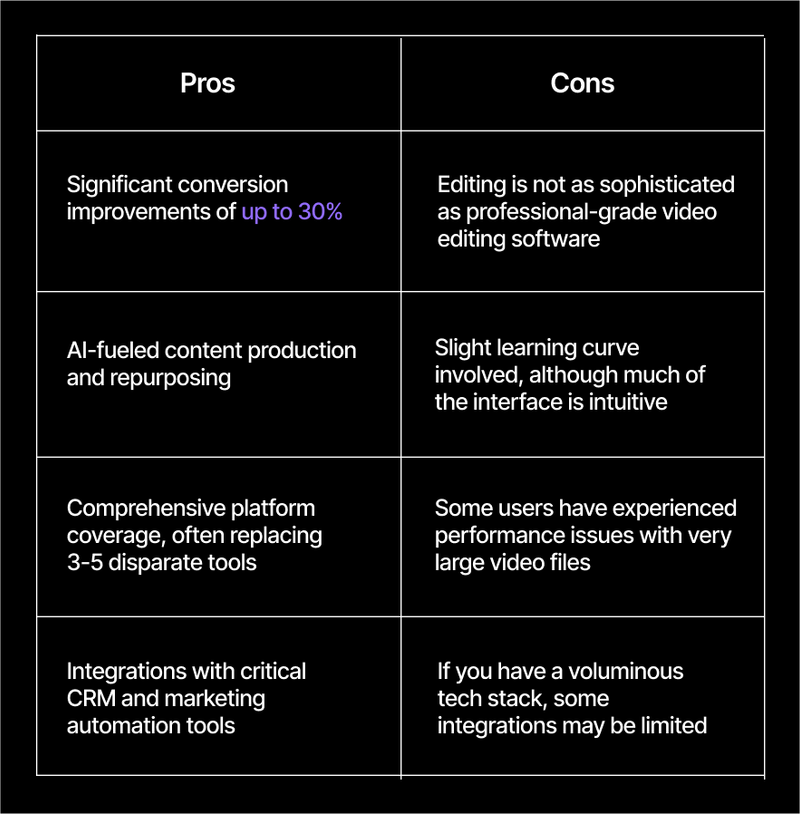
- Goldcast Recording Studio: Enables HD local recording with individual audio tracks and dynamic scene changes. Your podcast guests receive automatic calendar holds, and producers can manage everything from backstage. Text-based editing makes it as easy to edit your podcast as it is to edit a document.
- Goldcast Content Lab: AI content repurposing tool that transforms your podcast episode into a complete content suite. The AI identifies key moments, generates shareable clips with branded captions, drafts multi-modal blog posts with inline video, and creates social posts with relevant snippets. You can train it on your brand voice so everything sounds like you wrote it.
- Goldcast Events: A comprehensive platform for hosting webinars and virtual events with interactive features. Includes automatic calendar holds, polls, Q&A functionality, and seamless on-demand conversion.
- AI Search: Advanced search functionality that unlocks your entire content archive. Search by keyword, speaker, or topic to instantly find specific moments across all your episodes. Perfect for creating compilation content or answering questions like "what did our CMO say about demand gen last quarter?"
- Goldcast Agents: AI-powered workflows designed to automate video creation, optimization, and amplification. Streamlines the entire video production process from creation to podcast distribution and adds more bandwidth to your team, freeing you up to focus on high-level strategy.
Traditional podcast platforms force you to choose between recording quality, ease of editing, or distribution capabilities. Goldcast gives you all three, plus seamless integration with your B2B marketing stack and strategy.
Pricing
Goldcast's pricing is solution-specific. Reach out to us for a demo to see Goldcast in action and explore which products might work for you.
Who it's for
Goldcast is purpose-built for B2B marketing teams, specifically demand generation, content marketing, and event marketing professionals who view podcasts as part of a comprehensive strategy.
If you're measuring podcast success by influenced pipeline and content output rather than just download numbers, Goldcast delivers ROI that traditional podcast platforms simply can't match.
The platform suits mid-market to enterprise organizations ready to stop duct-taping together five different tools and start treating video content like the strategic asset it is.
Whether you're launching your first B2B podcast or scaling an existing program, Goldcast can help.
From Podcast to Pipeline Machine
See how B2B marketing teams use Goldcast to record, repurpose, and measure podcast content that actually drives revenue.
Podcast hosting and distribution platforms
Next up: podcast hosting platforms that handle the infrastructural side of podcasting: storing files, generating RSS feeds, and distributing episodes to directories like Apple Podcasts and Spotify. These are designed for creators who record and edit their content elsewhere.
Castos
Castos offers unlimited podcast and episode hosting for a flat fee, making it attractive for creators managing multiple shows. The platform handles distribution to major directories and includes private podcasting for members-only content. Their WordPress integration (Seriously Simple Podcasting) appeals to teams already managing content in WordPress.
Best for: Content creators with multiple shows who need WordPress integration and private podcast capabilities
Pricing: Starts at $19/month
Captivate
Captivate emphasizes workflow efficiency with its Creator Suite, which includes episode planning, research tools, and a dynamic show notes builder that pulls information automatically. The integrated guest booking system handles scheduling and reminders, while IAB-certified analytics ensure you're measuring real engagement, not just downloads. Unlimited podcasts and storage come standard across all plans.
Best for: Interview podcasters who want streamlined guest management and automated show notes creation
Pricing: Starts at $17/month
Podbean
Podbean combines hosting with AI tools that enhance audio and generate titles, show notes, and transcripts. The platform also converts blog posts into podcast episodes using AI voices and handles YouTube republishing. Free hosting covers up to 1,000 downloads monthly, with unlimited storage and bandwidth on paid plans.
Best for: Bloggers and video creators looking to instantly repurpose existing content into podcast format
Pricing: Free plan available; paid plans start at $9/month
Transistor.fm
Transistor stands out by allowing unlimited podcasts on a single account, each with its own RSS feed, website, and analytics. Dynamic ad insertion and private podcasting come built in, along with AI transcription as an add-on. The platform supports team collaboration with unlimited members and role-based permissions.
Best for: Podcast networks and agencies managing multiple shows who need separate team access for each podcast
Pricing: Starts at $19/month
Spotify for Podcasters
Spotify for Podcasters is completely free and provides hosting, distribution, and basic analytics. The built-in creation capabilities let you record, edit, and publish directly within Spotify. Eligible creators can monetize through the Partner Program's ad revenue sharing. The catch? Distribution to other platforms requires manual RSS feed submission, and many creator tools work only within Spotify's ecosystem.
Best for: New podcasters who want zero-cost hosting and are comfortable with Spotify-first distribution
Pricing: Free
NOTE: Other popular podcast hosting services include Buzzsprout, which offers an intuitive interface for beginners, and Libsyn, one of the longest-running platforms in the space. While these platforms provide solid hosting fundamentals, they lack the end-to-end workflow and content repurposing capabilities that B2B marketing teams need to maximize podcast ROI.
Recording, editing, and production tools
This final category of platforms focuses on the creation side: capturing high-quality audio and video, providing editing capabilities, and often including features like AI enhancements and multi-track recording. Most are built for remote collaboration, making it easy to record with guests anywhere in the world while maintaining professional production standards.
Riverside.fm
Riverside.fm captures 4K video and uncompressed audio locally on each device, ensuring quality regardless of internet stability. The platform combines recording with multistreaming to multiple platforms simultaneously and includes text-based editing for quick cuts. AI tools automatically create social clips and remove filler words.
Best for: Remote podcast hosts conducting video interviews who need reliable, high-quality recordings with editing tools included
Pricing: Free plan offers 2 hours of recording; paid plans start at $24/month
Podcastle
Podcastle uses AI to enhance audio, generate voices, and provide text-based editing for both audio and video. The platform includes recording, transcription, and hosting in one package. Magic Dust AI cleans up recordings, while voice cloning enables text-to-speech content creation. Cloud storage ranges from 2GB to 1TB.
Best for: Podcasters who want AI-powered audio enhancement and multilingual transcription in an accessible interface
Pricing: Plans start at $11.99/month
Descript
Descript revolutionized podcast editing by making it work like editing a document — edit your podcast by deleting text from the transcript, and the audio automatically adjusts. The Underlord AI assistant removes filler words, reduces background noise, and identifies the best clips. Studio Sound transforms any recording into professional-grade audio with one click. Descript Rooms also enable remote recording with automatic transcription.
Best for: Podcast editors who prefer text-based workflows and want powerful AI assistance for common editing tasks
Pricing: Starts at $16/month
Alitu
Alitu calls itself "the podcast maker" because it handles recording, editing, and publishing while automating much of the technical work. Magic Filters remove filler words and silences. The drag-and-drop episode builder works with reusable templates for consistent production. Free podcast hosting is included (up to 1,000 downloads), with automatic publishing to major directories.
Best for: Solo creators and small teams who want professional results without learning audio engineering
Pricing: Starts at $32/month
StreamYard
StreamYard focuses on browser-based live streaming and recording, allowing up to 10 participants without downloads. The platform multicasts to Facebook, YouTube, LinkedIn, and other platforms simultaneously while recording locally in 1080p HD. Built-in branding abilities add logos and overlays. Echo cancellation and AI noise removal ensure clean audio.
Best for: Podcasters who want to stream episodes live to multiple platforms while capturing high-quality recordings
Pricing: Free plan includes 2 hours monthly; paid plans start at the Core level (pricing varies)
How to choose your podcast platform
Choosing the right platform isn't about features on a checklist; it's about matching capabilities to your actual workflow and business goals. Consider the following:
- Recording capabilities: Does the tool capture audio and video locally on each device, preserving quality when internet connections wobble? Look for separate speaker tracks so you have flexibility in post-production. This separates professional tools from consumer-grade solutions.
- Content repurposing and distribution: The most powerful platforms transform podcast episodes into social clips, blog posts, and email content without requiring you to export files and jump to other programs. Seamless distribution to Spotify, Apple Podcasts, and other directories should happen automatically while you maintain control of your RSS feed.
- AI that you can work easily with: Text-based editing lets you remove filler words as easily as editing a document. AI should identify key moments, generate accurate transcriptions, and streamline everything from recording to publishing.
- Brand consistency: Can you apply customizable branding, dynamic overlays, and templates that make every piece of content recognizably yours?
- Analytics: For B2B teams, download numbers aren't enough. Look for platforms that provide advanced analytics including podcast statistics, demographics, engagement metrics, and integration with your CRM and marketing automation.
If you're evaluating Goldcast alternatives, ask yourself: Does this tool just do podcasting, or does it connect my podcast to my broader content strategy? Most platforms excel at one piece of the puzzle. Very few connect recording, editing, repurposing, hosting, and measurement in a way that actually drives business results.
Transform your podcast workflow with Goldcast
The podcast platform you choose determines whether your show remains a standalone project or becomes a strategic revenue generator. While hosting platforms get your content distributed and recording tools help you capture solid audio, only Goldcast delivers the end-to-end workflow that B2B marketing teams need to turn podcasts into pipeline.
From studio-quality recording that works anywhere to AI-powered repurposing that creates dozens of assets from each episode, Goldcast is built for teams who measure success by business outcomes, not just download numbers.
Ready to see the difference? Try Content Lab free, and experience how AI can turn your podcast into a content engine. Or request a Recording Studio demo to see how B2B teams are creating professional podcast content without juggling five different tools. Get started below!
Stop Juggling Tools. Start Multiplying Content.
Record once in Goldcast, and then watch AI generate clips, blogs, and social posts in your brand voice.
See Recording Studio in Action
Discover how B2B teams create studio-quality podcasts and customer stories without a production crew.
Podcast platform FAQs
How much storage do I need for a podcast hosting platform?
Storage needs depend on episode frequency and length. A weekly 60-minute podcast in high quality (128 kbps) uses about 60 MB per episode, totaling roughly 3 GB annually. Most platforms offer 5-20 GB on starter plans, which works for weekly shows. Consider unlimited storage plans if you're running multiple shows or releasing daily episodes.
Can I migrate my existing podcast to a different platform without losing subscribers?
Yes — just maintain your RSS feed URL or use 301 redirects to point subscribers to your new feed. Most platforms offer migration assistance and will import your existing episodes with metadata intact, so your audience keeps receiving new episodes.
What internet speed do I need for high-quality remote podcast recording?
Aim for 10-15 Mbps upload speed for 1080p video or 3-5 Mbps for audio-only podcasting. Platforms like Goldcast with local recording technology capture content directly on each device, so quality stays high regardless of internet hiccups during recording.
Do I own the content I create on podcast platforms?
You should! Reputable platforms grant you full ownership of your recordings, transcripts, and derivative content. That said, always review the terms of service and avoid any platform that claims ownership or broad licensing rights over your work.
How do copyright and music licensing work for podcasts?
You need proper licensing to use copyrighted music; fair use rarely applies. Stick with royalty-free music libraries (often included with platforms) or subscribe to services like Epidemic Sound, and always verify you have rights to any audio you include.
What's the difference between podcast hosting and podcast recording platforms?
Podcast hosting platforms store and distribute your finished episodes via RSS feeds to directories like Spotify and Apple Podcasts. Contrast that with recording platforms, which enable you to create content using remote recording, editing, and production tools. Many modern platforms combine both functions, offering end-to-end solutions from recording through distribution.
Can I run ads on my podcast if I'm just starting out?
Yes! Beginners can use affiliate marketing, sponsorships from smaller brands, or listener support through Patreon. Dynamic ad insertion typically requires 1K+ downloads per episode, so focus on building valuable content and growing your audience first. Monetization will follow naturally.
Transform Your Video Marketing with AI
© 2026 Copyright Goldcast, Inc. All rights reserved.
YOUR PRIVACY CHOICES