




 Upcoming Events
 Event Series
 On-Demand Events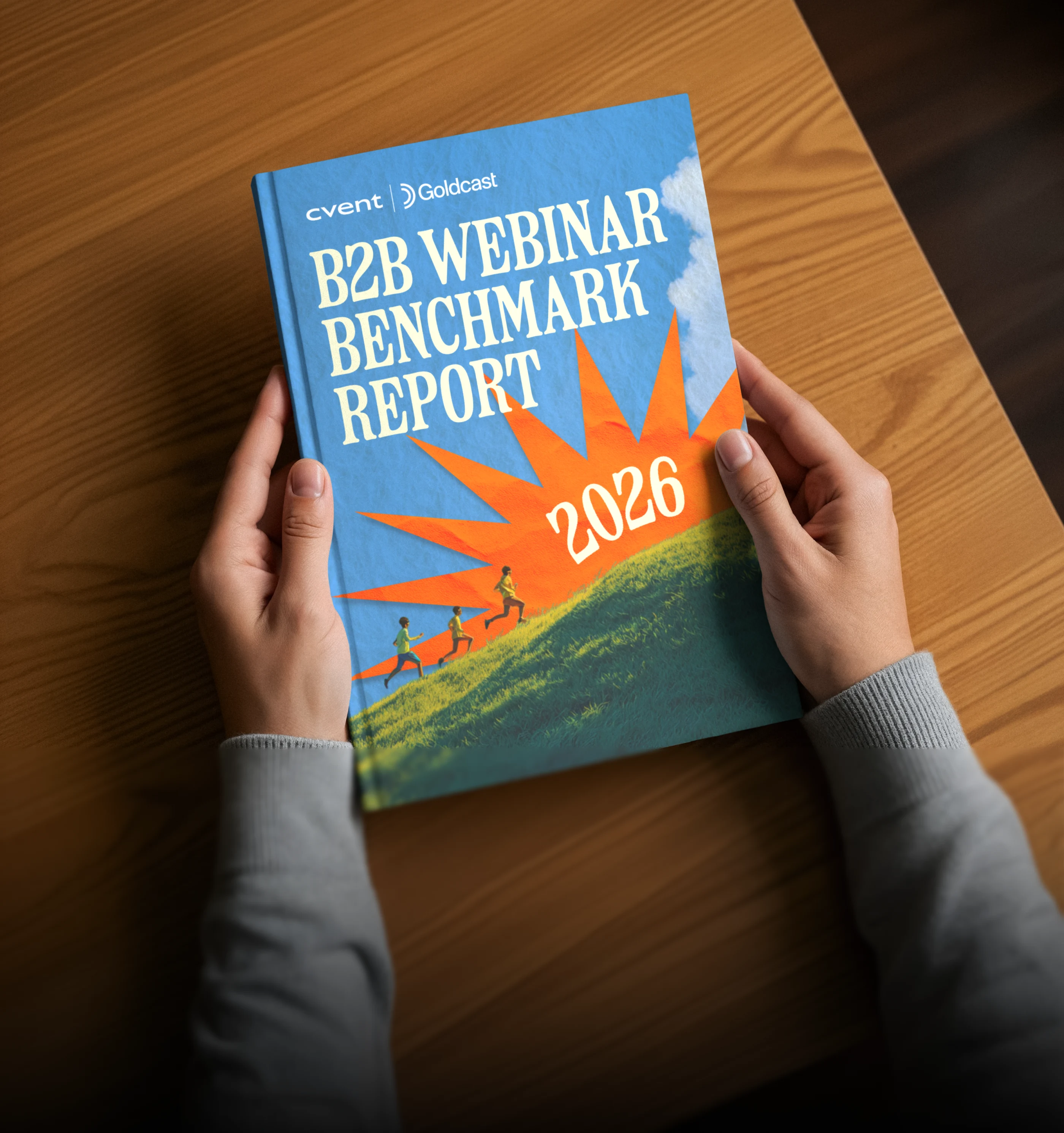


Are Webinars Still Effective in 2025? The Data Says Yes
Table of Contents
Maximize Your Marketing ROI
Join 10,000 other marketers already getting the best tips on running engaging events that boost pipeline and create raving fans.
Picture this: Your leadership team just asked you to justify the webinar program budget. You scan the numbers and realize that attendance dropped 15% this quarter. You're also getting feedback from sales that webinar leads never convert.
Meanwhile, your peer at another company claims their webinar program sourced $2M in pipeline last quarter 👀 What do they know that you don't?
The "old school" webinar approach doesn't work now
Let's get one thing straight: Webinars are still one of the most effective B2B marketing channels in 2025. But effectiveness also varies widely between companies, and it all comes from the way you approach your webinar strategy.
There are two main ways to think about webinars:
- The "old" way: Zoom meetings, no content repurposing … you know the vibe.
- The modern approach: Premium branded experiences, multi-channel amplification, direct pipeline tracking … basically, the Goldcast way.
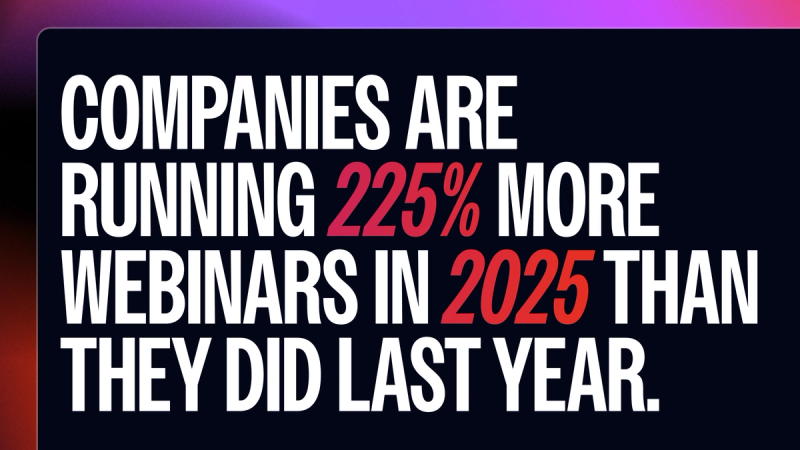
The second approach works — and we've got data to prove it. Our 2025 B2B Webinar Benchmark Report analyzed 19,531 webinars across 418 B2B brands, and we uncovered that
Plus, Goldcast CEO and co-founder Palash Soni shared some insights with DemandGen Report on the future of webinars. One thing he noted stood out:
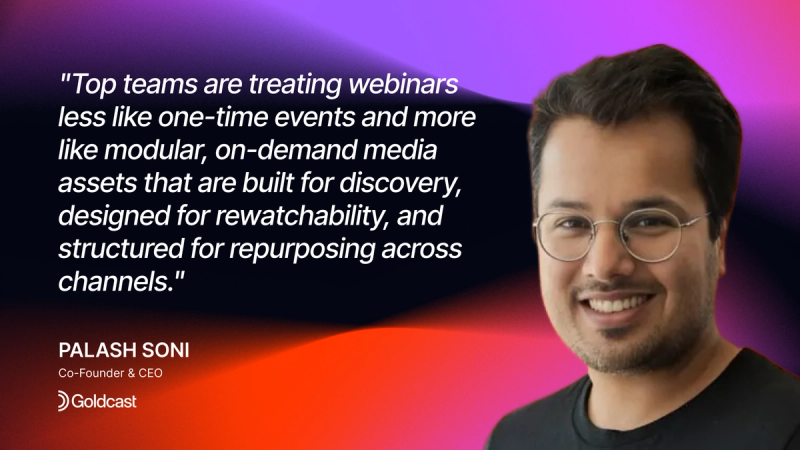
Together, these two sources reveal the fundamental shift that allows some webinar programs to drive millions in pipeline while others waste budget. Read on to discover what the data says about webinar effectiveness in 2025.
What the numbers say about webinar effectiveness in 2025
If webinars weren't effective, companies wouldn't be running more of them. Yet your average brand hosts around 47 webinars per year — nearly four per month. That's not the way marketers treat channels that don't deliver ROI. Instead, we're seeing increased investment in webinars because they deliver measurable, scalable results.
On-demand consumption extends far past the live event
As Palash put it in his DemandGen Report interview, "Today's B2B buyers don't always want to sit through a 45-minute session—they want the gist, faster. They're looking for on-demand access, short-form clips, highlight reels, and key takeaways they can quickly scan or share. That's why 80% of webinars on our platform are now offered on-demand: it's a clear sign that high-performing teams are recognizing the shift and adapting."
That number he's referring to — 80% of webinars hosted on-demand — isn't just our webinars. It's all of Goldcast's customers' webinars. That means 80% of all the webinars we analyzed for the Benchmark Report are available to be viewed after the event ends. It's clear that marketers use on-demand webinars as a way to get more runway.
Interestingly, 31% of live attendees go back and watch the on-demand recording after they've attended. This suggests that people find a massive amount of valuable content in webinars — so much so that they'll revisit the key takeaways later on!
AI-powered repurposing drives exponential content creation
We mentioned the modern approach requires a shift in thinking, and repurposing is a huge part of that. There's been an absolute explosion in content repurposing recently, with teams using AI tools like Goldcast Content Lab to quickly turn each webinar into social media video clips, blog posts, email campaigns, and more.
In 2025, Goldcast customers used Content Lab to create:
- 2,903% more video clips than in 2024
- 11,464% more text-based assets
What used to take weeks (or months) of manual editing work now happens in just minutes, allowing one webinar to fuel weeks of multi-channel campaigns. The type of content being created has also shifted. Email (37.1%) and social posts (36.8%) are now the top assets being created, as companies strive to meet people where they naturally hang out.
Webinar isn't a bad word anymore
In a fascinating reversal, we realized that people are actually flocking to events with the word "webinar" in the title. For years, if you titled your webinar as such, you saw significantly lower performance.
In 2024, that flipped, and webinars called "webinars" saw 66% more registrations and 9% higher attendance.
Why? Well, we think this proves that the webinar experience is still highly relevant. Audiences are proactively signing up for webinar events because they know they're not gonna get the standard Zoom-fatigue experience they grew to dread in the early 2020s. Today's webinars are polished, professional, engaging, informative, and just flat-out fun — and people are willing to show up for them.
The performance gap: high performers vs. everyone else
Let's close by taking a look at these webinar statistics:
- Average webinar registrants: 238
- Average webinar attendees: 51
- Average webinar attendance rate: 33% — up from 29% last year!
These averages obviously mean that there are high and low performers on the spectrum, but there are some things that the top range does consistently to boost attendance rates.
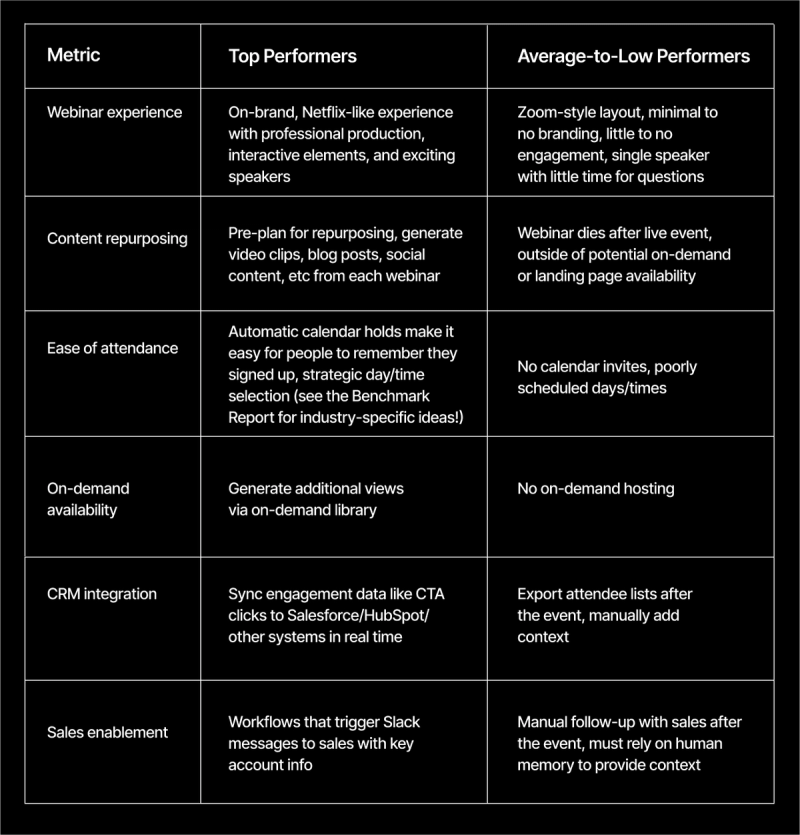
The bottom line: High performers aren't doing well by chance. They're taking strategic steps to ensure that virtual events function as powerful content engines, not isolated "check the box" events.
See How Your Webinars Stack Up
Compare your webinar performance against industry benchmarks with data from 19,500+ events.
Why some webinars fail (and what that tells us)
If webinars were easy, everyone would succeed. The performance gap between high performers and the rest of the pack is proof that execution matters. Here are some reasons why some webinars don’t fare as well as others, plus how to solve for each one.
Generic experiences create Zoom fatigue and kill differentiation
Many teams are still hosting webinars on standard platforms with default layouts, minimal branding, and static slides. There’s no way to tell the webinar apart from the string of daily Zoom meetings people have to join for work and just like that, you’ve lost people. There’s no brand awareness being built because the webinar looks the same as everything else. People aren’t engaged, sales teams don't receive enriched data about qualified leads, and conversion rates stay low.
Solution: Platforms like Goldcast Events provide interactive features and create branded, differentiated experiences — all without the help of a professional production team. Each event allows you to engage with your audience via polls and Q&A, plus you can use professional overlays and transitions to keep viewers watching.
We’ve custom-built Goldcast so B2B marketers can connect with their audiences. Features like automatic calendar holds make it easy for people to attend your events, and they can boost attendance by 20% or more. During the event, the Goldcast platform tracks every action attendees take, and sales receives valuable data they can personalize before reaching out.
Treating webinars as one-off events destroys ROI and limits reach
Webinars shouldn't be just an isolated moment in time. You’ve already put so much time into producing the webinar content; why let the finished recording sit untouched afterward? Your live webinars only reach a small percentage of your audience, and most of the attendees will only watch it once.
With this model, cost-per-lead stays high. Your content folks can’t get off the production treadmill because they’re making everything from scratch, all of the time. Leadership sees webinars as expensive and questions whether they’re worth the investment.
Solution: When you repurpose webinars with a powerful tool like Goldcast Content Lab, you leverage AI to automatically generate clips, blog drafts, and social posts in minutes, multiplying ROI without adding headcount.
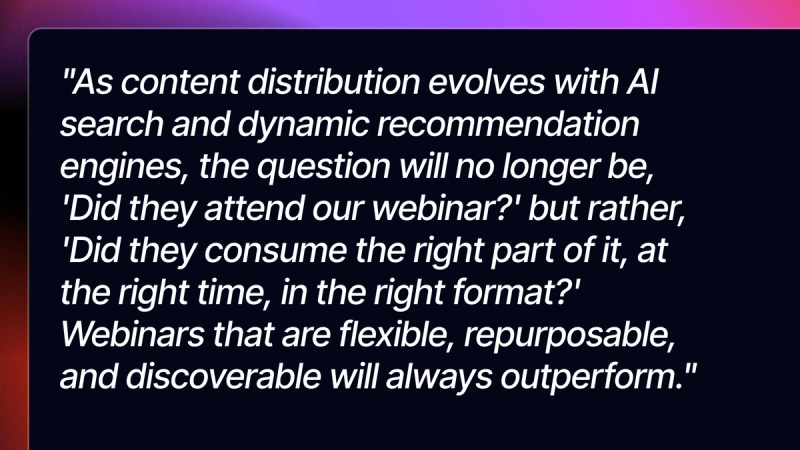
Savvy marketers plan for amplification before the event begins, identifying “clippable” moments during content design. During repurposing, one webinar becomes 8-12 video clips in multiple formats, 2-3 blog posts, 6-10 social posts, and 3-5 email sequences. AI tools automatically generate transcripts, identify key moments, create video clips, and draft copy. Human review is still needed, but much of the work is automated.
The result? You reach 5-10x more people with your webinar marketing content. Cost-per-impression drops. One webinar fuels 8-12 weeks of campaigns, freeing you up to think about high-level strategy.
Measuring vanity metrics hides real impact and breaks the marketing-sales loop
The third big misstep we see is tracking things like registration numbers and attendance percentages. Meanwhile, sales receives attendee lists with minimal context.
Spoiler alert: This should be reversed! Traditional metrics like attendance tell you very little (if anything) about intent, readiness, or fit. As a result, sales treats all leads identically because they don’t know who to prioritize. Then, when you’re questioned on webinar ROI, you refer back to the traditional metrics but soon realize they don’t actually connect to revenue.
In this scenario, neither marketing nor sales has the data they need to optimize for conversions.
Solution: Goldcast captures 20+ engagement data points — including resources downloaded and questions asked — and syncs to your CRM in real-time, enabling lead scores based on actual behavior and immediate sales Slack alerts. Plus, you can track performance over time.
The modern webinar playbook: Create, amplify, measure
The most successful B2B teams execute on a repeatable system. They create the content, design systems to amplify it, and then measure its performance. This is how you turn webinars from a time and cost suck into a full-on revenue engine.
Create: Capture content designed for multi-channel reuse
Creation starts with strategic planning. Define success before you even schedule the webinar. Which buyer stage are you targeting? What key messages matter to your target audience? Which repurposed clips are you hoping to get?
Recording quality is paramount because you’re going to use this content for months to come. Select a platform that captures HD video and separate audio tracks. Look for interactive elements like polls, Q&A sessions, resources, and CTAs to generate engagement signals you can send to sales.
Goldcast has two options for content capture. There’s Goldcast Events, which has all the rich engagement features you want for your webinar audience. There’s also Goldcast Recording Studio, a dedicated recording suite for pre-recorded content that offers superior video and audio quality.
The best part? Both Goldcast Events and Recording Studio automatically send your recordings to Content Lab so you can quickly repurpose all of your content.
Amplify: Transform one webinar into dozens of channel-ready assets
This is where you really see the webinar ROI kick up. Your live event may reach 100 people, but your amplified content can reach thousands.
Immediately after the webinar ends, the post-webinar fun begins. Goldcast Content Lab scans the transcript, flags the key moments, and starts generating video clips, blog copy, social media drafts, email newsletters, and more. Humans review and refine for brand voice and strategic alignment, and then the content is ready to be distributed.
Current Goldcast data shows that you can expect to repurpose 20x more content in just a few hours, saving $2,000 per clip and giving you so much time back. Not only are you able to consistently show up on platforms like LinkedIn and YouTube, but you’re able to do so in an on-brand, cohesive way.
Measure: Connect every interaction to pipeline and revenue
Measurement closes the loop between marketing activity and business outcomes. Capture granular engagement: polls answered, questions asked, resources downloaded, clicks, etc. Then sync everything to your CRM, and trigger immediate Slack alerts when target accounts engage so sales can follow up right away.
Goldcast grabs 20+ data points throughout the webinar and monitors post-event performance through pipeline and revenue metrics. The most-engaged accounts are identified so sales knows where to focus their efforts, and you’re able to show leadership which webinars contributed to won deals.
Webinars work when you work the playbook
The data settles the debate: Webinars work. The 225% YoY growth and thousands of successful webinar programs prove webinars are one of the most effective B2B marketing strategies.
The question is whether you’re being effective by following the Create, Amplify, Measure playbook that turns webinars into lead generation engines — or whether you’re still subscribed to the yawn-inducing, old-school approach.
Platforms like Goldcast consolidate everything you need: event hosting, content repurposing, and pipeline measurement. This makes the entire Create, Amplify, Measure framework feasible for even the leanest B2B marketing teams.
Here’s your next step:
- If you’ve got a webinar program in place, audit it against the data in this year’s B2B Webinar Benchmark Report. Find out how you stack up against high-performing teams, and hone in on what you need to address.
- If you’re starting a new webinar program, be sure you’re building it on a platform that will allow you to scale. Develop your first webinar using the Create, Amplify, Measure framework. Track engagement and pipeline, and see what works.
- If you’re on the fence about webinars, look to the data, not people’s opinions. Run a pilot webinar using the Create, Amplify, Measure framework and pay attention to your results vs other channels.
Webinars work when you work the framework. The teams generating millions in pipeline aren’t luckier than you, and sometimes they aren’t even better-resourced. They’re just executing a repeatable playbook backed by data.
See Goldcast
From premium branded experiences to AI-powered repurposing, see how Goldcast turns webinars into revenue engines.
Effective webinars frequently asked questions (FAQs)
How do webinars compare to other content formats like short-form video or in-person events?
Webinars excel at depth and interaction that short-form video can't deliver, while scaling reach in a way that in-person events can't. The benchmark data shows the smartest teams don't choose between formats — they integrate them. Host a webinar, clip it into short videos for social, embed those clips in blog posts, and gate the full recording in an on-demand hub. Webinars become the engine that fuels all other channels.
What are the biggest mistakes that kill webinar effectiveness?
Here are three of the biggest mistakes we see:
- Promoting too late. Be sure to start 3-4 weeks out with multi-touch sequences.
- Ignoring the replay audience. Half or more of webinar consumption happens on-demand, yet some teams still only optimize for live.
- Creating content in a vacuum without repurposing planning. The 2,903% YoY increase in video clips created shows winners plan repurposing before the webinar starts, identifying which moments become clips and which sections become posts. If you're not planning amplification upfront, you're leaving 80% of potential ROI on the table.
Are webinars right for my business, or should I focus on other channels?
If you sell complex products requiring detailed explanation, build relationships through thought leadership, or operate in B2B environments with longer sales cycles and committee buying, you should use webinars as a core part of your strategy.
The data shows webinars work for most B2B companies when executed properly — the 225% growth found in our Webinar Benchmark Report proves this isn't a niche tactic. The key is to look for webinar platforms for branded experiences, systematic amplification workflows, and CRM integration.
How is AI changing webinars, and what should I prepare for?
AI has eliminated production bottlenecks that used to require specialists. Teams now produce, on average, 4 webinars a month. Activities like repurposing used to take weeks after the webinar ended, but AI has reduced that to a few hours. The future is flexible, and people want different options for how they attend and watch your webinar and the resulting repurposed content.
How do I calculate true webinar ROI beyond attendance metrics?
Real ROI tracking requires three layers:
- Pipeline attribution that connects webinar engagement directly to influenced opportunities in your CRM
- Content multiplication metrics showing how many repurposed assets each webinar generates and their cross-channel performance
- Engagement quality over quantity — the ability to track polls answered, questions asked, resources downloaded, and view time
Platforms like Goldcast now sync this granular data to Salesforce and HubSpot automatically, so you can see which specific webinars contributed to closed deals instead of defending budgets with registration counts that don't connect to revenue.
Transform Your Video Marketing with AI
© 2026 Copyright Goldcast, Inc. All rights reserved.
YOUR PRIVACY CHOICES